Showing posts with label yuri. Show all posts

Saturday, 12 September 2020

The Fairy's Song Review (Yuri Visual Novel)

The last time we talked about a “modern fairy tale” VN with a yuri spin to it, it was a very special one – Studio Elan’s Heart of the Woods, which I confidently gave my first and, so far, only 5/5 rating. The way it mixed relatable, modern characters with an emotional fantastical plot resulted in an experience in many ways unmatched within the EVN scene. It also showed the huge potential of this formula, handling the clash between mundane and supernatural in a different way than typical fantasy or horror stories. Today we’ll be looking at a game that took similar themes and utilized them a more low-key, light-hearted way – ebi hime’s newest yuri VN, The Fairy’s Song.

                Released on Steam and Itch.io early August 2020, this project is a slight departure from ebi’s usual, angst-filled storytelling, focusing more on cute romance and comedy. Fairly similar in tone to 2016’s Strawberry Vinegar, which also combined modern-day slice of life story and supernatural elements, it plays on classic themes of knights, monsters, magic and sleeping beauties, but puts them in a configuration that gives the whole setup a very different meaning… Which doesn’t necessarily mean The Fairy’s Song manages to offer many surprises or that it feels particularly fresh in how it utilizes those tropes and story elements. But why is that exactly, and is it really a bad thing?

But have they really…? There is certain sloppiness to The Fairy’s Song's lore and the overarching fantasy plot, but thankfully it can’t overshadow the charm of the characters and the yuri romance

The Fairy’s Song's protagonist is Marnie, a goth teenager who tries to make up for her small stature and naturally cute looks with dark clothes and a (slightly) mean attitude. We meet her when she’s being dropped to her grandmother’s house in a small, remote village, quite unhappy with the time she’ll have to spend there while her parents travel abroad. Her grumpiness is only strengthened by the fact her grandmother, struggling after the death of her husband a year earlier, is a shadow of her former self – not just frail and weighted by her loss, but also disturbing her family with frequent talk of fairies and other magical phenomena supposedly present in the surrounding forests. However, what was meant to be a boring and depressing stay is turned on its head when Marnie ignores her grandmother’s warnings and walks deep into the forest. There, she is confronted with several inexplicable events, but most importantly, she discovers an unconscious girl dressed like a knight – Leofe, who apparently spent centuries sleeping in the enchanted grove and is now determined to repay Marnie for waking her up.

                The story from this point is slightly messy and strangely-paced but also has quite a lot of charm. The fantasy subplot suffers from a few inconsistencies (like Leofe claiming her magic comes from the forest’s fairies and later describing them as untrustworthy and hostile to humans) and rather predictable mystery elements. Its interplay with the slice-of-life moments also leave a little bit to be desired – the premise would make you expect the main couple spending quite a lot of time in the enchanted forest encountering various magical phenomena, but those moments were few and far between and felt a bit disjointed from the mundane drama. This mild sloppiness and lack of dedication to the theme felt uncharacteristic for ebi’s writing, but thankfully the story worked much better in the most crucial departments: the characters and the relationship between Marnie and Leofe.

…also, at no point fairies show up on screen and there’s no trace of the titular fairy songs, but there’s enough fay magic and enchanted woods in the story that you’re unlikely to feel cheated

Marnie represents the angsty teenager archetype that can easily become irritating, but she is actually a nicely balanced character, with enough self-awareness and compassion to never become off-putting. Her fierce attitude also makes her adapt pretty quickly even in extreme circumstances, which comes in handy a few times when she encounters supernatural dangers. She does not change much during the story, her attitude softening rather in response to specific circumstances than due to some internal epiphany, but she’s compelling enough as a character for that not to be a problem. Leofe, even outside of a few secrets and plot twists she’s involved in, is an interesting character that only over time I fully appreciated. Her over-the-top, knightly persona and constantly-declared devotion to Marnie might feel absurd at first, but the role of that facade becomes more understandable later on. Stranded in an unfamiliar world, one in which she has no place to call her own, falling back to her ambition of being a knight is a defence mechanism that she initially relies on to keep on going. As her relationship with Marnie deepens, we can see her attitude and mannerisms becoming more natural – this aspect of both girls gradually lowering their defences and becoming honest with each other is one of the most compelling aspects of the whole VN. A lot of good can also be said about the supporting cast, particularly Marnie’s family. Her parents have fun personality quirks that make them believable and fairly defined despite their limited screentime. Her grandmother is a little bit more one-note (same can be said to characters connected to Leofe/the enchanted forest), but full of warmth and she supports Marnie in crucial moments of the story, which makes her plenty likeable.

                Then, there’s the yuri relationship itself, which includes choices that may or may not be to your taste. While the game is fully kinetic and ends on a very positive note, it doesn’t go very far in developing the love story, as the girls end up still slightly uncertain about their feelings and what their future will look like. There’s also no epilogue that shows them being together, which is a bit of a wasted opportunity in a story that is in large part about finding a place for oneself in an alien world. Just a little glimpse to how Leofe was going to adapt would be very satisfying. Overall, there are enough cute moments and kisses to satisfy most yuri fans, but I hoped for something a bit more conclusive. The game also mostly avoids explicit LGBT themes – while Leofe’s past as a girl going against social norms and striving to become a knight has a clear feminist/empowerment angle to it, neither hers nor Marnie’s attraction to women is ever elaborated upon. While I know some readers prefer things to be this way, for me at least acknowledging the issue makes the story more immersive, so I wish the game was at least a little bit less vague.

In a major way, The Fairy’s Song is also a tale of waking up in an unfamiliar world and trying to find a place for oneself – with all the troubling and ultimately-heartwarming implications

The game’s visuals are kept relatively close to standard anime art and they are overall very cute and colourful, setting an appropriately light tone. The level of detail didn’t amaze me at any point, but the character art, backgrounds and UI are all nicely stylized and fit together very well, creating an overall very pleasing effect. Music caught my interests a bit more, as it mixed typical slice-of-life VN ambient tunes with more dynamic ones reminiscent of JRPG soundtracks. The switches in style complemented the transitions between more mundane and more adventure-filled segments of the story – a choice that felt well thought out and deliberate, which is not necessarily true with most EVN soundtracks. Generally, the VN left nothing to complain about from the technical standpoint, a few typos scattered throughout the story being the biggest issue I can think of – and even those were relatively few and far between.

                So, do I recommend buying and reading The Fairy's Song? Generally speaking, yes, but it's also not an offering that will completely satisfy fans of ebi's usual storytelling, or those seeking for a cohesive and engaging plot. With how casual the flow of this VN was and with some of the quirks in its art reminding me of Winged Cloud's Inma Ruiz's work, I sometimes couldn't suppress the feeling like I'm reading clean, better written fragments of a Sakura game. Personally, I'm all for that kind of low-brow fun, as I can easily get past some messy plotlines and enjoy cheesy romantic moments, but you need to adjust your expectations properly to not feel at least a bit disappointed approaching such a game. The Fairy's Song will occasionally ask you to embrace its silliness and go along with a few overly-convenient plotpoints, but if you're able to do that much and if you enjoy cute yuri romance, you'll have tons of fun with it.


Final Rating: 3,5/5


Pros:

+ Fun main couple with good chemistry

+ Lovely visuals

+ Good soundtrack


Cons:

– Mild inconsistencies in the game’s writing

– Very standard plot that adds nothing fresh to the formula


VNDB Page

Buy The Fairy’s Song on Steam or Itch.io

Saturday, 29 August 2020

Synergia Review (Yuri Visual Novel)

Have you seen Blade Runner 2049? The cyberpunk epic that charms the viewer with its climate and polished visuals, but is probably a bit too convoluted for its own good and offers relatively little payoff for its massive, multi-layered plot? Now, imagine watching that movie without the context of original Blade Runner and accompanying shorts, all offering crucial pieces of worldbuilding and linking the main entries in the franchise together. How much meaning the sequel would lose and how hard to follow some of its subplots would be?

                This “Blade Runner 2049 without context” metaphor is the best way to explain my feelings about Synergia, the long-anticipated cyberpunk EVN by Radi Art. First announced in mid-2017, the project gathered a lot of attention with its well-defined, gloomy aesthetic and an appealing story outline. After that, it went through a number of hiatuses, with the creator behind it often going silent for long months and many assuming the project was dead. In mid-2019, however, the full development of the game was resumed and after a successful Kickstarter campaign (and another series of delays), we finally received a finished product in August 2020 – one that, in my opinion, proved way less mystery-filled and more flawed than the promotional materials made us hope for. But why is that exactly and to is this game actually bad, or just not living up to the hype?

The few characters central to the Synergia’s plot showed great promise, however, most of them remained relatively unexplored and their stories left without closure

Synergia tells the story of Cila, a police operative and negotiator specialized in dealing with androids, living on a far-future, desert-covered colony planet. Serving as a private contractor to the oppressive imperial government, the dominant polity of the unnamed world, she’s depressed and demotivated, barely managing to fulfil her duties despite being highly-trained and skilful in dealing with both AI and augmented humans. Soon after the game's start, however, her apathetic routine is broken when her best friend Yoko, a shady android merchant and gang leader, gifts her a replacement to her recently-defunct companion android. The new robot, Mara, seems incredibly advanced and human-like – arguably more human than the repressed and corrupt population of the imperial capital – and astonished Cila with her unpredictable and independent behaviour. Soon her unclear origins and level of intelligence, suggesting the use of illegal forms of AI, become signs of trouble, which Cila is unsure how to deal with. However, even she does not expect the real depth of the conspiracy and the significance the android might have to the future of her country (and, possibly, the whole colony).

                While this setup sounds both fairly typical for cyberpunk fiction and decently complex, the way the VN approaches exploring its story is pretty unique and depending on your interpretation can be considered either minimalistic or plain lacklustre. With just a bunch of characters dominating the plot, extremely limited use of exposition and very few opportunities to explore the setting in any significant fashion, we get a core story that is largely suspended in a narrative void. Crucial elements of the plot like Cila’s past traumas and broken career within imperial special forces are very shallowly explored, while other central characters, like Yoko, barely get any development at all. I’m all for subtle storytelling and natural presentation of background information, but Synergia just gives the reader way too little to work with. The way the world is presented is even more cryptic, with some contextual information present (like web articles and messages occasionally showing up when you use computer interfaces), but not enough to get a cohesive sense of the setting. The Empire in particular, while its presence is talked about a lot in the game, is never showed much or interacted with in a manner that would justify its menacing reputation. This might be less of a problem to some readers, but for me exploring interesting visions of the future is a huge part of the appeal of cyberpunk as a genre and Synergia underdelivers heavily in this regard.

The game’s red and blue-tinted, neon aesthetic was one of its major draws and the final art do not disappoint – that is unless you find the heavily-skewed color pallet jarring

Then there’s the pacing and overarching intrigue related to Mara which are not bad, but also not spectacular. The game is relatively lacking when it goes to tension and sense of danger. Fights or confrontations are few and far between and Cila is barely ever put in real danger, which is kind of out-of-place considering her perilous line of work and the powers she’s working against in the latter half of the story. There’s also a very real lack of story development around the midpoint of the plot, before the game branches out to “good” and “bad” route (the difference in tone between them is not as huge as those labels would suggest, with “bad” ending being more of a “neutral” one). Particularly, this is the portion when the romance between Mara and Cila should be given time to grow and gain meaning, but that’s simply impossible within the brief segment between the main intrigue being established and the final act kicking in. This makes even the yuri aspect of the game feel underdeveloped – also because we learn very little about the “mechanophilia” incident from Cila’s past, one that could give more depth to her character, her feeling for Mara and even the overall setting, as her tragic "love affair" with an adroid had serious repercussions for the whole Empire.

                The resolution of the mystery plot, involving Mara’s origins and the significance of her existence, was quite imaginative, but some parts of it were also pretty contrived and unconvincing. Synergia’s promotional materials were giving a vibe of outlandish conspiracies and, possibly, deeper transhumanist themes, while the game itself was trying to build tension with a mysterious countdown to the “Synergia incident”. The real resolution of the plot was hardly that spectacular and Cila’s role in it somewhat irrelevant – whenever she has significance for the overarching story, it’s because of what other characters want from her or because of something she did in the past (and the game never shows those events, just briefly references them). While her initial apathy is explained in the plot, she’s the kind of protagonist I really don’t like in VNs – it’s fine for MC’s influence and agency to be realistically limited, but here they’re not only being tagged along by greater powers, their most interesting moments are also delegated to the vague backstory. This doesn’t make Cila a bad or unappealing character, but a poorly-utilized one – exactly because she’s a genuine badass that should get more than two or three scenes taking lead.

The game’s red and blue-tinted, neon aesthetic was one of its major draws and the final art do not disappoint – that is unless you find the heavily-skewed color pallet jarring

From this you could probably get the feeling that I disliked Synergia or that it’s an overall poor experience, but that’s not the case. The major elements boosting its enjoyment factor are definitely the art and music. Visuals are highly-stylized, with a dark and distinct colour pallet that boosts the gloomy and oppressive feeling of the setting. While sprites and CGs are relatively simple when it goes to the level of details, they look appealing and very in-line with the cyberpunk formula. The soundtrack is exactly the kind of electronic ambience music you would hope for in a game like this and I enjoyed it a lot. At the same time, it always stayed comfortably in the background, without even threatening to distract me from the reading (which is exactly how I like things to work). Before I conclude the review, however, I also have to mention another important problem of Synergia: the English script is weighted down by spelling mistakes and occasional awkward phrasing. These issues weren’t massive, but visible enough even for a non-native speaker such as me, so take them into consideration.

                So, what’s my ultimate take on Synergia? Despite all the complaining I did, the issues I write about were not something that could ruin my experience, but rather areas where I saw clear wasted potential. The game tried to tell a complex story but did not take the time (it's 6-7 hours of content) and attention to detail necessary to fully immerse the reader. I could much more easily look past the main intrigue not blowing me away if the game’s world and main characters felt alive and decently fleshed out, but they always fell short of that threshold. The result is a game that is fun enough to follow for fans of the genre, but one that never manages to rise above purely average levels. Maybe the free story DLC promised by the author will do something to give the experience some real depth, but for now, I can only recommend Synergia to people who’re particularly fond of the cyberpunk aesthetic and themes – while it hardly adds something new to the formula, it’s a decent enough iteration of it, especially on the relatively-barren landscape of cyberpunk VNs. And if the author decides to expand this universe, it can still hold a lot of promise – the foundation is solid, it just needs a lot more substance on top of it to truly shine.


Final Rating: 2,5/5


Pros:

+ Great cyberpunk aesthetic

+ Climatic soundtrack


Cons:

– Weak worldbuilding

– Underdeveloped/underexplored characters

– Average-at-best main intrigue and mysteries


VNDB Page

Buy Synergia on Steam or Itch.io

Friday, 17 July 2020

NaNoRenO 2020 Highlights, Pt 3: Romance VNs (Non-otome Edition)

Dl7719.png

Hello there and welcome to the third and final part of my NaNoRenO 2020 highlights! While in the first two posts I focused, respectively, on otome and horror VNs, this last batch of recommendations will be about other romance stories submitted to the event. I have to admit upfront that this is likely the least exciting list of the three, with no game standing out to me in a similar way as Enamoured Risks did among otome entries or Eislyn's Apocalypse did among horror ones. However, there's still a bunch of solid and interesting titles in this category, my favourite being probably Café in the Clouds, with its lovely visuals and memorable dreamworld sequences. Also, the jam has something to offer for fans of all typical romantic configurations, with BxG, BL and Yuri couples strongly represented.

                 As always, all the games I'm writing about are completely free to download, and clicking their titles below will get you straight to their Itch.io pages. Also, I've skipped projects that were submitted to the event but proved low quality or did not offer a complete experience (meaning I exclude all demos and prototypes by default). So, please join me as I wrap up this insane, months-long project of thoroughly covering the biggest NaNoRenO in history – hopefully, you'll find something interesting among my recommendations.


Love Rewind: A Magical Time Travel Romance (BxG/BxB)

Love Rewind is a short romance story with one male and one female love interest, themed around regret and desire to change the past. Yuki, the protagonist and young mage-in-training, loses everything in a futile attempt at saving his terminally ill mother. Broken by this failure and the destroyed relationship with his fiancée Quinn, he isolates himself from the world – an empty, depressing existence that would likely last for the rest of his life if not for the appearance of a spirit, taking form of a cat. This powerful creature forces on him an opportunity to relive and change the events that led him to ruin, and regain the love he lost – or maybe forge a different path altogether…

                  This VN, while a bit rushed and lacking the proper buildup particularly for the BxB arc (Quinn’s route at least have the background of protagonist’s relationship from the original timeline), has a few things going for it. Yuki is a decent protagonist, whose desperation and pain are easy to emphasize with, and the core story has all the satisfaction inherent to plots where you avert a looming disaster. The love interests simply don’t have enough time to develop as characters and truly shine, but they work well enough as incentives for the protagonist to not repeat his past mistakes. The end result is not a great romance VN, but a nice short story in its own right – and one that looks and sounds very solid for a game jam entry.

Final Rating: Recommended

Weekend Fever (BxG)

Weekend Fever is a minimalistic, but emotional story about a writer struggling with burnout, unable to create stories or even find the passion for the line of work switched to after his endeavours as an author died down. While on a short business trip to his hometown, his mind filled with a mix of nostalgia and discouragement from his current circumstances, he meets a stranger – a woman who inexplicably rekindles his passion for writing…

                While the core plot of this VN might not sound very inspired, its value lies in the atmosphere it creates and psychological depth of the main character. Passages of his unfinished book are mixed with rather excellent descriptions of his emotional distress and obsessive drive to create that shows up immediately after he finds inspiration. The visuals and sound are simple, but the colour pallet and distortion effects used in backgrounds create a surreal effect, adding to the slightly detached, nostalgic feel of the narrative. The romance is basic, but full of emotional impact thanks to the fact how connected it is to protagonist’s struggles – all this makes for a satisfying short story, worth experiencing regardless of whether you’re looking for romantic content.

Final Rating: Recommended

Flour Hour (BxB)

Flour Hour is a well-though-out BL romance story weighted down by one massive issue – its prose. The English script is not only full of errors and awkward phrasing typical for non-native writers, but also uses Japanese honorifics in a particularly pointless way, making the whole thing feel like a poor fan translation. Which is a shame, because the underlying story has quite a lot of merit. The main intrigue features Yuki, an owner of a bakery created in place of his grandmother’s flower shop, being approached by a lawyer with claims of massive debt his business owns to a powerful corporation. The desperate struggle to save the titular Flour Hour coincides with a reappearance of Souma, a former boyfriend Yuki never really got over, and increasingly suspicious behaviour from his sole employee, Izumi.

                Flour Hour’s drama and intrigue prove surprisingly in-depth when you get further into the story. While some developments are pretty silly and the choice system maybe a bit too unforgiving, the characters offered more nuance and development than I expected. Souma was probably the most interesting in this regard, as his abrasive and borderline-abusive behaviour becomes much easier to understand when he finally opens to Yuki about his feelings and his experiences after they broke up. At the same time, the story is simply hard to get into with the clunky writing, strangely-stylized visuals and poor-quality CGs. If you can look past those issues, however, the VN might be worth reading not just from the perspective of BL fans – to me, its core plot and the way romance was handled felt very universal.

Final Rating: Cautiously Recommended

Demon Kiss (BxB)

Demon Kiss is quite likely the best-looking and most polished game on today's list, featuring a really cute BxB romantic plot between a socially-anxious computer technician, Felix, and Trisetar, a demon noble that accidentally kidnaps him to hell. Shocked by the human's strange attitude and non-fearful reaction to his presence, the demon gradually lowers his defences as the two are stuck together for a few months (time necessary to recreate the spell for travelling to the human world).

                Despite the pleasing art and generally fun, lighthearted storyline the game is not without some issues, the main being its pacing. There is an overarching plot connected to Trisetar's initial appearance in the human world, but it's basic at best and generally stays in the background of the developing romantic tension... Which also doesn't develop as much as it probably should. With no bad endings or really tense moments, the story has a pleasant flow to it, but fails to get the reader engaged other than on a very superficial level. As the result, I would only truly recommend reading this one to dedicated BL fans – while the humour and the final plot twist are fun enough even for an average reader, the main focus is the fluffy BxB love story that should mostly satisfy people who are explicitly after that kind of content.

Final Rating: Cautiously Recommended

At First Sight (BxB)

At First Sight is an unusual story utilizing a very interesting concept – in a world where everyone has a destined soulmate with whom they spend their whole life, the protagonist, Grimes, approaches his forties without finding one. When Dreams – a rare form of premonition happening to the Unsouled and hinting at the identity of their future partner or the circumstances they’ll meet under – start appearing to him every night, he’s more terrified of the uncertainty of following the visions and possible disappointment than he is encouraged. And when he finally decides to act on his premonitions, what he finds is detached from his expectations way more than he ever feared…

                At First Sight is technically a BL game and gay romance is present in it in some ways, but above all, it’s a story putting various romance clichés on their head. Grimes is an unpleasant and frustrated person, and in the world where everyone receives a happy ending by default, he ends up with something that even in the best possible interpretation can hardly be called a love story. His reactions are often nasty, even beyond what is justified by his depressing position, making his a relatively unlikeable protagonist. However, the way the game explores the idea of soulmates, and the strange situations and tensions it creates in its world is genuinely interesting – for that element alone At First Sight might be worth investing around 30 minutes necessary to complete it.

Final Rating: Recommended

Kill the prince!? (BxB)

Kill the Prince!? is a tiny story about a thief hired to assassinate a prince kidnapped by a rival kingdom and forced to marry their princess. Cute and very humouristic, the game gradually reveals the connection between the protagonist and his target, while also delivering amusing dialogue, a cast of exaggerated characters and silly puzzles centered around switching disguises.

                The game’s art is in decent part composed of simple lineart or rough sketches and the whole experience is very brief (20-25 minutes to fully read through), but it has enough charm and wit to justify its existence. The love story in it is also lovely to the point where even someone like me, who usually struggles to get into BL games, genuinely enjoyed it. If you’re looking for a short, fun distraction rather than a deep story, this one is definitely worth it.

Final Rating: Cautiously Recommended

Café in The Clouds (GxG)

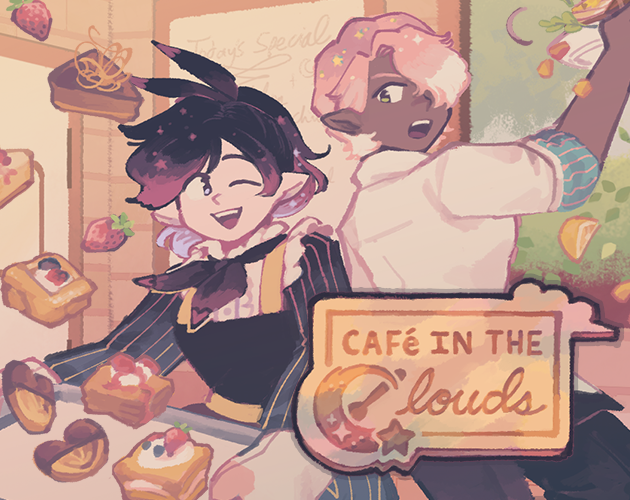
Café in the Clouds is a short yuri VN with point-and-click adventure game elements. It tells a story of two women running a very unusual café in a modern-fantasy setting. Outside of simply serving food and coffee, they possess magical powers that enable them to enter their client’s dreams and help them deal with nightmares, or even deep-rooted problems disturbing their nightly rest. The game’s plot focuses mostly on one such case – a client that visits the café (or rather passes out at the entrance) to ask for help with their severe insomnia.

                The romantic elements in this VN come in the form of relationship between the owners of the café, Remerie and Somnia. The interactions and banter between them are very cute and a near-constant feature of the brief story, accentuated by pleasant, pastel-painting-style visuals. Other than that, the player has to deal with a few simple puzzles (and a single unnecessarily cryptic one at the very end) to navigate the client’s dream and find a way to clear out the issues preventing them from resting at nights. The game also teases a larger story, connected to the couple’s mentor and original owner of the café – a story I would be quite interested in reading, considering what a genuinely nice experience Café in the Clouds proved to be.

Final Rating: Highly Recommended

Tender Feelings Like Water (GxG)

Tender Feelings Like Water is a short, supernatural love story about a water spirit that gains a sense of self and after long years, maybe centuries of loneliness falls in love with an unsuspecting human girl. Disguising themselves as another woman, the spirit starts interacting with the mysterious "girl in red", wary to not reveal their true identity – not just due to possibility of scaring her away, but also because the river, the personification of which they are, took away a lot from both the girl and her village in general...

              As simple as this VN was (also when it comes to the visuals and the soundtrack, which are both not unpleasant, but basic), I couldn't help but enjoy its nostalgic storytelling and emotional conclusions (there are two endings, similar to each other, but different in subtle and meaningful ways). It's a yuri romance in a very loose understanding of the term, but should satisfy most fans of the genre with its climate and interesting dynamic between the main characters – and maybe other readers too, if they adjust their expectations properly.

Final Rating: Cautiously Recommended

In Peaceful Days (GxG)

In Peaceful Days is a Fire Emblem: Three Houses fan fiction VN expanding on the Empire route and Edelgard romance (with female Byleth). It focuses on a rare day off, when both the protagonist and the Empress have some time to spend together, away from political intrigues and military conflicts. Byleth sets to prepare a perfect evening, interacting with other characters from the source game and visiting important locations within Garreg Mach.

                A short, cute piece of (non-sexual) fanservice, this VN has enough visual polish and humour to satisfy the fans of the original, but even for someone like me, who never played Three Houses and only did short research to know the context of the story, it was pretty fun to read.  It also has the advantage over many projects of this kind that it's not going outside of the canon with its main pairing and character interactions, but elaborates on one of the possible endings of Three Houses in a believable way. Recommended primarily for Byleth/Edelgard fans, but not necessarily just for them.

Final Rating: Cautiously Recommended

Honourable Mention:

Full Service Shop (GxG/Non-Binary)

Full Service Shop is less a romance story and more a lesbian/non-binary erotic game using its sci-fi setting to create a number of really interesting, softcore scenarios for the player to go through. It features a nameable protagonist in the late 21st century, where advanced cybernetic implants are widely available. This includes the ability to enhance or replace one’s genitals and our main character is on their way to such a procedure, choosing a small, peculiar workshop – the titular Full Service Shop. There they’ll be able to not only choose their new implant (which changes how the scenes play out in minor ways) but also one of the four technicians who will not only install the new implant but give them a thorough “test drive”.

                As trashy as this premise might sound, it’s handled in a quite interesting way, with each technician offering a unique backstory and sex scene, the latter ranging from short and vanilla to complex and kinky. Visuals are tame, majority of the time stopping at partial nudity, so most of the work is done by the genuinely high-quality writing. The stories revealed in the conversations with the technicians and the erotic content itself utilize the futuristic setting, for example by discussing digitalizing the human mind and spicing things up by manipulation of neural implants, providing the much-needed variety when compared to your typical erotic VN. The one complaint I have about the game is arguably a major one – with average visuals and choices that don’t add too much to the experience (apart from initial choices of implant and technician, they mostly can just cut the scenes short), to the point the whole package would work just as well, or maybe even better as a short story. Still, if you’re looking for an unusual, wholesome erotic VN to read, this issue hardly makes it less of a valid choice.

Final Rating: Recommended


And this is all for today's list and, by extension, my coverage of the NaNoRenO 2020. The non-otome romances that showed up this year mostly failed to truly impress me, but games like Cafe in the Cloud still managed to provide fun experiences while a few other proved memorable by escaping the usual tropes and story structures. There are also a few slice-of-life titles that I might add to this post as further honourable mentions – the enormousness of this year's event makes my work of covering it constantly feel incomplete, but for the most part, it's done. I hope you enjoyed what I provided here and will consider giving a chance to VNs I've recommended – I'll do my best to repeat this process next year with NaNoRenO 2021 and this fall with Yuri Game Jam 2020. But for now, thank you very much for your time and I hope to see you again!

Saturday, 4 July 2020

Eldritch University Review (Yuri Visual Novel)

Note: I was provided with a free review copy of the game by the developer. All opinions are solely my own.

Sequels to obscure, low budget EVNs are always a slightly awkward topic to tackle. They are inevitably tied to games which few people are familiar with and which can be, at least in some aspects, of subpar quality simply due to their indie nature. This makes giving a meaningful rating and recommendation for potential readers tricky – at the very least, any kind of conclusion about them will be served with a good number of caveats, related to the interplay between titles in the particular series and the value proposition they represent both together and on their own. The latest title to create such a conundrum for me is Eldritch University by Jackkel Dragon.

                Released on Steam in June 2020, this game is a sequel to early 2019’s Eldritch Academy, a supernatural horror VN combined with a fair dosage of high-school yuri romance. While amusing in its romantic arcs, the prequel had several issues: unlikeable protagonist, repetitive routes, below-average visual and, in my opinion, an unreasonably high price for the level of quality it represented. University, while borrowing the setting and tying itself loosely to the core intrigue of that game, represents a major improvement in most aspects – a better-looking, more focused experience with a price tag way more representative of its entertainment value. Is it, however, good enough to make the whole series worth it, or to be a viable read as a standalone experience? Well, it depends on what you want from it…

The troubled relationship between the protagonist and her girlfriend is the most interesting part of the game – and the most satisfying, when you finally see them succeed

Eldritch University follows the story of Kasumi, a college freshman that was recently reconnected with Misaki, the girlfriend she was separated from three years earlier. A secondary character from Eldritch Academy, Kasumi was the person who unwittingly unleashed the supernatural threat that game's story revolved around and nearly got killed in the process. Still bearing some emotional scars from the incident, she was mostly able to regain her easy-going attitude and is happy to work on rebuilding her relationship with Misaki. However, when the wound she sustained back then starts giving off strange symptoms, and creepy stories of apparitions begin popping out around the campus and the surrounding town, it becomes clear that the horror is far from being over.

                I won’t try to hide it: if there’s one thing I deeply enjoyed about Eldritch University it is the love story between Kasumi and Misaki and the way it is tied with the overarching supernatural intrigue. Initially, Kasumi herself is a bit of a bubbly airhead, while Misaki is more timid, but also kind and friendly. As, in the prequel, we briefly observe the couple in their high school days, they are outgoing and over-the-top affectionate to each other. However, the circumstances of their separation (forced by Misaki’s conservative mother) and the time they spend apart change that significantly. Misaki’s is weighed down by the social stigma and rejection she suffered due to being a lesbian, while Kasumi struggles to adapt to her changed behaviour and the doubt on whether the connection they once had can be fully rebuilt. In both of the non-dead-end endings, this dynamic gets resolved in a satisfying and heart-warming fashion, while never overdoing the drama and keeping the emotional and psychological profiles of both girls very believable. Coupled with a romantic, non-explicit sex scene, this makes Eldritch University a real treat for yuri fans such as myself – I was genuinely surprised and impressed with how impactful it was.

The game’s supernatural story feels somewhat rushed and underdeveloped, but also avoids repetition and filler content that plagued Eldritch Academy

The horror intrigue is less developed and is probably the only aspect of the game which I would consider weaker than it was in Academy, which focused a lot on stress and desperation of fighting against a supernatural threat. It ties directly to the events of the first game and creates a few genuinely tense scenes, but its main value is, once more, in the well-executed interplay with the love story. The character most important for the horror arc, Kasumi’s friend Hinata, plays into her insecurities and confusion about Misaki’s behaviour – this leads to a few interesting choices influencing the main couple’s relationship. On the other hand, the are also blind choices with unpredictable consequences in horror scenes and the pacing of the whole mystery plot feels rushed. With frequent time skips and rapid story developments, the sense of looming danger and despair, for which the game was definitely aiming, is only half-there. Also, surprisingly little was added to the series' overall lore and worldbuilding – it neither showed anything truly new about its supernatural elements nor opened interesting story threads for possible continuation.

                Then we get to the issue of secondary characters, who can be hardly described as anything more than plot devices. Two girls helping the protagonist and Misaki, Yuri and Shizuka, are a tie-in from the author’s book, Shireishi, but without the extra context someone who read that would probably have, they’re simply exposition props. Other minor characters barely show any personality either – Kasumi’s other friend, Hiroshi, is probably the only meaningful one among them. And at last, there’s the issue of actual relevance of knowing Eldritch Academy, as the really important parts lay not in the main plot of that game, but in the unlockable bonus content – short episodes showing the circumstances of Kasumi and Misaki getting separated and the way they adapted to their new situation. They add weight to the drama of University, but hardly justify investing time (8-10 hours) and money ($12) in the prequel. Honestly, I would just prefer to see a recap of Eldritch Academy and the scenes expanding on Kasumi’s and Misaki’s stories in University, as a skippable prologue – it would make it much easier to recommend it not only to people familiar with the first game (or interested in reading it), but also those that want to jump straight into the sequel.

Outside of Kasumi’s two friends, Hinata and Hiroshi, the secondary characters in the game are more plot devices than anything else – and even these two receive relatively little development

The visuals are a clear improvement over Academy, but are still pretty basic. While the sprite designs look more clean and expressive than they did in the prequel, the low amount of detail and simple shading are still very much visible. CGs look solid most of the time, but are ultimately on the same level as the sprites and occasionally even struggle with perspective. The end effect is hardly an eye candy, but very serviceable. The same can be said about music, which… Exists. It’s a very generic set of background tunes, but never gets in the way or fails to match the climate of the scene, which is good enough in my mind.

                So, what’s my conclusion on Eldritch University? It’s a game that struggles a bit with its identity, stylising itself as a horror story but hardly committing to this theme. However, for yuri fans that enjoy a more grounded approach to LGBT+ issues, it has enough to offer to easily justify the $6 price tag (for 3-4 hours of content). Also, for people that enjoyed Eldritch Academy or specifically look for the combination of supernatural thriller and GxG romance, it should prove satisfying. For anyone else, it might be a much harder sell… But if anything I wrote here sounded interesting to you, I still suggest giving it a chance – if not for the full price, then at least grabbing it on sale. And if this dev’s work continues improving in this manner, their next game might be very easy to recommend, even to a broader audience.


Final Rating: 3/5


Pros:

+ Excellent romantic subplot

+ Likeable and well-developed main cast


Cons:

– Average-at-best visuals

– Rushed/underdeveloped supernatural horror storyline

– Underdeveloped secondary characters


VNDB Page

Buy Eldritch University on Steam or Itch.io

Friday, 1 May 2020

Mizuchi 白蛇心傳 Review (Yuri Visual Novel)

4291fff43d7244f0848fa762908ef652_original.png?ixlib=rb-2.1.0&crop=faces&w=1552&h=873&fit=crop&v=1531028835&auto=format&frame=1&q=92&s=8c2f2962549e7bb3f63d54f757fb7b4c
Anyone observing the EVN scene should know well that yuri, besides being my personal obsession, is one of the most vibrant niches for non-JP visual novels, with many studios and creators dedicated to this theme and a very active fanbase. This seems to be particularly clear nowadays, as even companies like Winged Cloud, the infamous producers of low-effort VN smut, capitalized majorly on the trend, producing mostly GxG games for the past few years. On the other side of the spectrum, Studio Elan recently pushed the standard of quality for EVNs in general with their modern fairy tale, Heart of the Woods. As a result, yuri fans have a lot to choose from, both when it goes to quality work and amusing trash.
                The game I’ll be writing about today, Aikawa Collective’s Mizuchi 白蛇心傳, definitely aimed for the “quality” side of the spectrum and seemed like something that could rival Studio Elan’s hit with its climate and visual spectacle. This yuri-themed retelling of the famous Chinese folk tale, the Legend of the White Serpent, looked spectacular in its promotional material and easily reached its Kickstarter goal of $8500 in September 2018. While the development cycle for it proved long, going 9 months beyond its initial target of August 2019, it never lost its place as a promising and highly-anticipated yuri EVN. Releasing on Steam and Itch.io in mid-April 2020, it gathered overwhelmingly positive feedback – but, did it truly live up to the hype?
ddw6xgp-6f641483-fcef-4f3e-9968-0ffa4af4d913.png?token=eyJ0eXAiOiJKV1QiLCJhbGciOiJIUzI1NiJ9.eyJzdWIiOiJ1cm46YXBwOiIsImlzcyI6InVybjphcHA6Iiwib2JqIjpbW3sicGF0aCI6IlwvZlwvYThiODgzNTUtYzhjNy00YjE2LThhN2EtNGFhOWZjMWIwNGZmXC9kZHc2eGdwLTZmNjQxNDgzLWZjZWYtNGYzZS05OTY4LTBmZmE0YWY0ZDkxMy5wbmcifV1dLCJhdWQiOlsidXJuOnNlcnZpY2U6ZmlsZS5kb3dubG9hZCJdfQ.w8yXhejt5iLSqCFcdOLKcYP-spL8XmOb5x3oLDVL9ro
Don’t worry, for those like me not blessed with proper knowledge of Japanese, these scenes get explained later on, but not knowing what is said is actually pretty important for the game’s mystery and climate-building
 
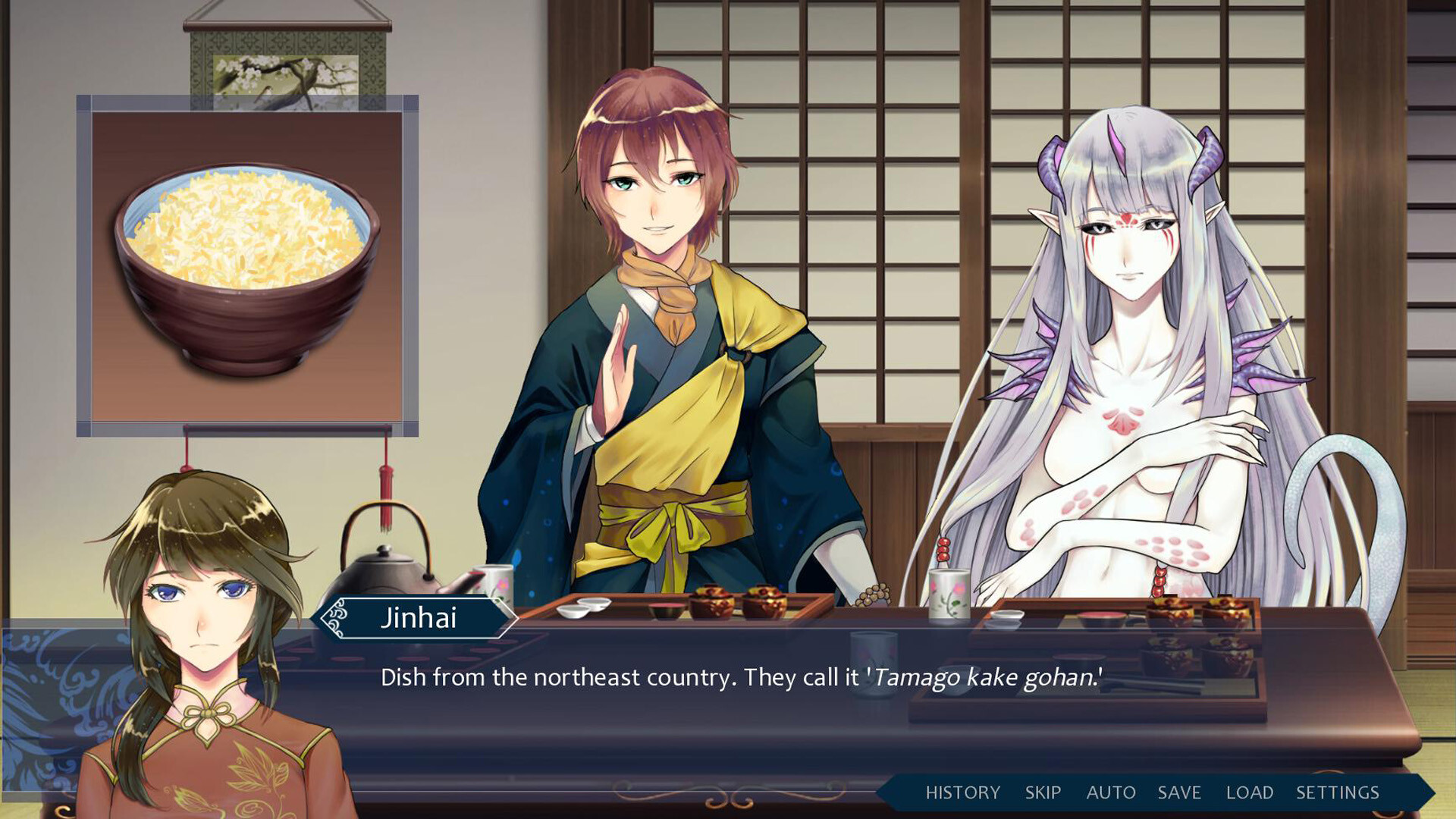
Mizuchi is a story of a young, poor peasant girl from the game’s equivalent of medieval China (her default name is Linh, but it can be changed). After years of living a harsh, but simple live as youngest daughter of the family, she’s unexpectedly proposed to by her childhood friend, who just came back from serving in a war. Just a few days later, after discovering something unexpected about her fiancée, she’s falsely accused of adultery and as a “trial” thrown into a pit of snakes. Left for certain death, she’s miraculously saved by an entity she assumes to be the serpent god revered by her community and wakes up in an unfamiliar house, whose only other inhabitant seems to be the said deity, now using a monstrous, half-serpent, half-human form. Terrified and confused, she has to navigate this new situation, made even more complex by the arrival of Jinhai – a strange, but kind female monk with a deep-running and turbulent relationship with the serpent goddess.
                While Mizuchi incorporates many fantastical elements, particularly with the serpent goddess, Ai, being a major focus, at its core it’s a slice-of-life VN, spending most of its time on the backstories and personal development of the three main characters. This is often done with slow-paced, casual interactions and depictions of daily life in the estate, near-perfectly isolated from the outside world. For those expecting a more dynamic story, or even a primarily romantic one, this might be a disappointment, as you’ll find in it at least just as many discussions about cooking and the local variety of mushroom as you might scenes that contribute to the romance or plot progression. This casual-feeling routine is only occasionally broken up by more dramatic events or tension, with the main axis of conflict being what Jinhai perceives as Linh’s imprisonment or forced servitude to Ai. Things change significantly in the final act of each route, with a lot more stress on supernatural phenomena and higher stakes, but this part might be slightly hard to get to for anyone not tolerant to slow pacing and very subtle character development.
135038.jpg
The amount of ultra-casual moments and “pointless” trivia sometimes threaten to devolve into genuine boredom, particularly in some of the scenes in Jinhai’s route
 
The reason I nearly never had a problem with the game’s relaxed approach to storytelling is that the setting and characters it builds are excellent enough to justify it. Linh starts overwhelmed and hurt, limited in her understanding of the world and striving to come back to her familiar home despite the struggle and possible danger that awaits her there. Her journey is mostly one of understanding her full potential and the injustice of the position she held in her village, which she previously considered as natural and inescapable. She’s believable in her reactions and the game delves pretty deep into emotional mechanisms of trauma, with which she has to deal with over time. All this definitely has a touch of female empowerment in it, as Linh has to break free of the constraints and common sense thinking of her extremely patriarchal and conservative community, with Ai offering her broader perspective on the world and promising new opportunities. Thankfully, it’s done well enough to never feel like pandering and is not exactly detached from the historical realities of medieval China the game takes inspiration from.
                Ai’s and Jinhai’s arcs are harder to talk about without spoilers, but the goddess in particular make for a really interesting character. As a powerful, shape-shifting spirit often moving between the worlds of nature and that of people, she has an attitude that combines a form of misanthropy with curiosity about humans and appreciation of specific individuals. Her arc is mostly themed around fully understanding humans and being able to grasp the love and devotion they often show to each other – a wish clearly signified by her adopted name. Jinhai is arguably a lesser character, as she’s defined mostly by her relationship with Ai and the responsibility she feels to keep her in check. The development she receives is definitely not as deep as that of the other two main characters and her route, by extension, is less captivating – which doesn't mean she isn't plenty likeable and doesn't have her own inner conflicts to resolve.
                I previously mentioned that Mizuchi’s romance arcs are not its central focus and I’m willing to stand by this claim, although I have some conflicted feelings in this regard. The game does some really excellent things when it goes to showing intimacy between the characters when the romance finally blossoms, with a set of mature, but not explicit scenes for both routes (inexplicably delegated to a patch on Steam, while they definitely should be a part of the core package and can hardly be considered "adult-only"). The road to those scenes is, however, kind of cliched and pale in comparison with how interesting the backstories of the characters and the core intrigue are. The positive part is that each route adds something to the understanding of the overall story and lore of the game’s world. Still, the non-romantic “harem” ending felt most satisfying to me, which is really weird for a yuri fanatic such as myself. My only explanation is that seeing all the characters staying together and overcoming traumas of their pasts simply feels like the best possible outcome, so this friendship scenario ends up being more satisfying than romance that naturally pushes someone out of the equation.
135034.jpg
The game does a good job of including some nudity and intimacy without explicit visuals – all mild and tasteful enough that the inclusion of Steam content patch for much of it feels pretty uncalled for
 
Now, for genuine complaints, I have very few, but my biggest one is probably the choice structure. It relies on an invisible affection system, with some choices contributing to it in a less-than-intuitive manner. This means that reaching some of the 5 endings, particularly the true ending for each heroine, can be really frustrating without a guide – while the number of choices is not massive, the sequence you need for those is really specific. Also, the execution of some of the endings was somewhat lacklustre, as they not always managed to explain well-enough what was going on and maintain reasonable pacing. Also, it’s clear that even among the “true endings” Ai’s felt a lot more robust and satisfying, showing where most of the team’s focus actually went.
                Visually, Mizuchi is absolutely beautiful, although it definitely prioritizes quality over quantity. Because the action of the VN is limited to less than a dozen locales, all the illustrations are really high-quality and do a great job of projecting the far-eastern-legend feel of the story. Sprites do not have much variety when it goes to poses and clothes, but once more make up for it with being highly-detailed and gorgeous – and to be fair, the sheer amount of forms Ai shapeshifts into required quite a lot of work to portray properly, in practice creating a significantly higher character count. CGs are relatively few and the high quality of other art kind of prevents them from having as much impact as they would in an average EVN, but that latter part is something I wish I could complain about more often. The music is fairly tranquil in its feel, matching the overall climate of the story – it was very pleasant and never got in the way of reading, which is just what I want from a VN soundtrack.
                In summary, Mizuchi is a game with a slightly niche appeal, due to its heavy focus on slice-of-life content and one that occasionally doesn’t seem to rise to its authors’ ambitions (particularly with the impact of the romance subplots). Despite all that, though, I found it to be a rather excellent experience, with charming characters and story that should satisfy not only yuri fans – while it doesn’t shy away from delving into the GxG love stories, its most important parts are much more universal. Its climate and unique approach to the far-eastern setting are something that should appeal to a broad audience and I recommend every VN fan that wasn’t scared off by my earlier criticism to give Mizuchi a chance. Also, as Aikawa’s debut, it’s a very promising achievement – hopefully, they won’t stop there.
 
Final Rating: 4/5
 
Pros:
+ Beautiful visuals
+ Well-constructed, unusual fantasy setting
+ Likeable heroines
+ Good psychological depth of the main characters
 
Cons:
– Uneven pacing and occasionally dull slice-of-life content
– Unintuitive choice system
– Romance subplots lack impact


VNDB Page
Buy Mizuchi on Steam or Itch.io

Friday, 7 February 2020

Rituals in the Dark Review (Yuri Visual Novel)


Note: I was provided a review copy of Rituals in the Dark by Marantana, author of the game's German translation.

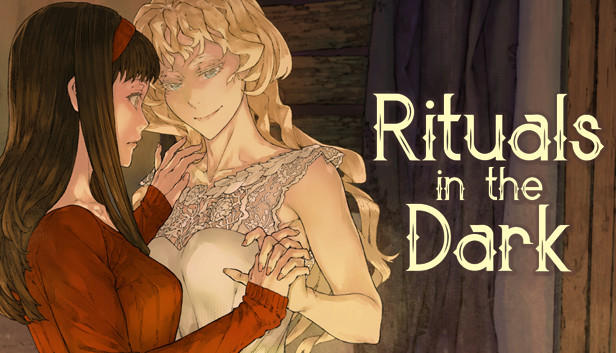
Rituals in the Dark, published on Steam November last year, is the latest yuri release by ebi-hime, one of the most highly-regarded EVN developers. Those familiar with ebi’s work probably know that her history with yuri is as long as it is unique. Most of her games add unusual spins to the formula, or at the very least showcase her distinct writing style, very introspective and painfully realistic in its portrayal of human nature. This makes even the more conventional of her w/w love stories, such as Blackberry Honey (check out my review of it here) stand out through their pacing and often uncompromisingly painful plotlines. All this is usually coupled with strong attention to quality and general writing prowess, making her EVNs some of the best on the market when it goes to literary qualities.
                This newest project shares many staple elements of ebi’s style. Mixing long sections of NVL-style narration and retrospection with more typical segments of character interactions, it creates a slow-paced experience, focused a lot on the protagonist’s thoughts and feelings. At the same time, it might be one of the first cases where, in my experience, some parts of ebi's formula felt a bit bothersome, particularly because what kind of people the major characters turned out to be. It’s also the shortest and most minimalistic commercial game ebi has released since 2017's Sweetest Monster, in a way bridging the gap between her larger projects and the freeware games she was creating in the past. So, what are Ritual in the Dark’s main problems and do they fully spoil the compelling experience you’d expect from a VN by ebi?
qQckyw.png
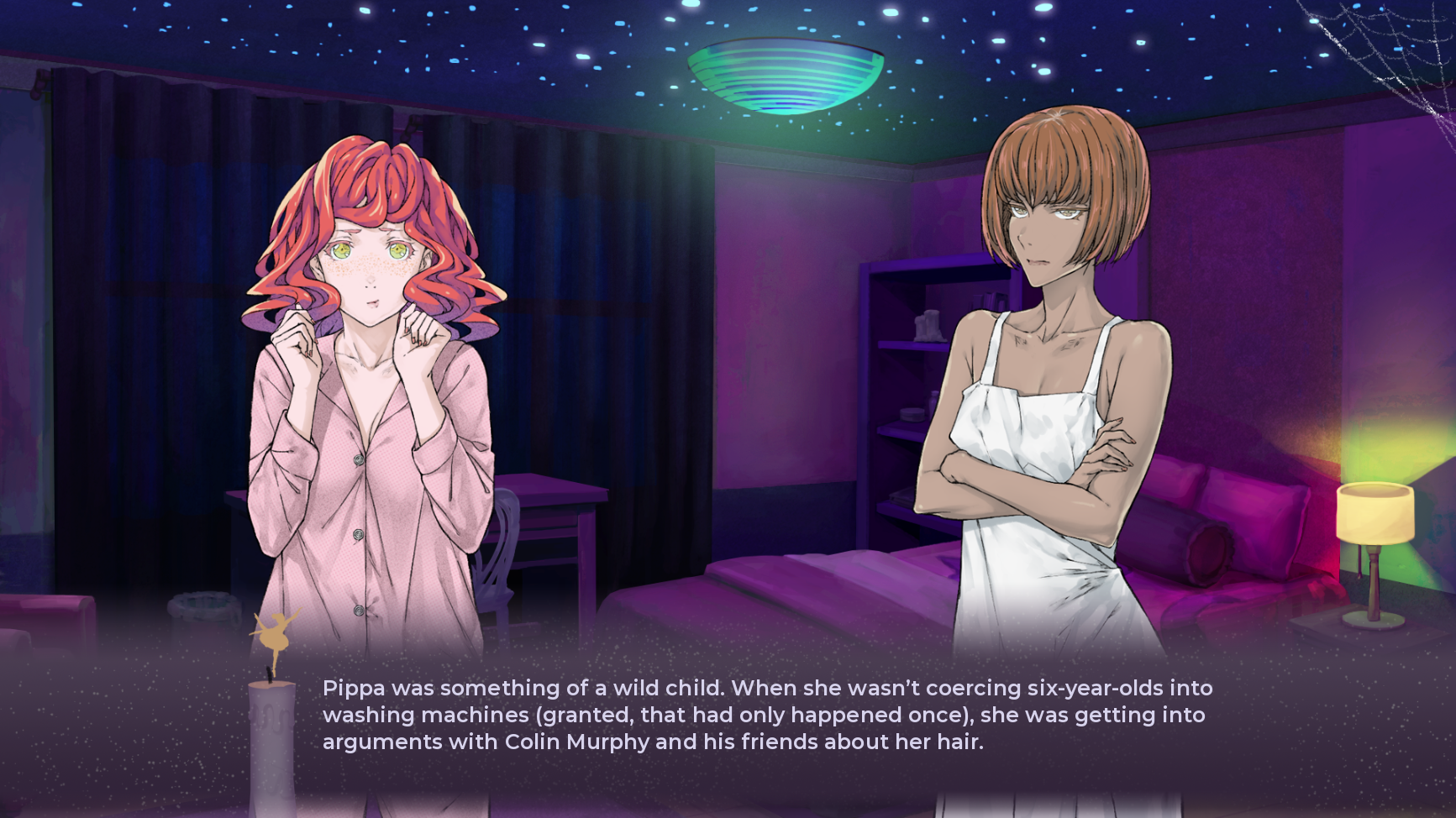
The protagonist Aspen and her friends, Lakhi and Pippa, are very much ebi-hime characters – believable, but flawed to the point of frustration
 
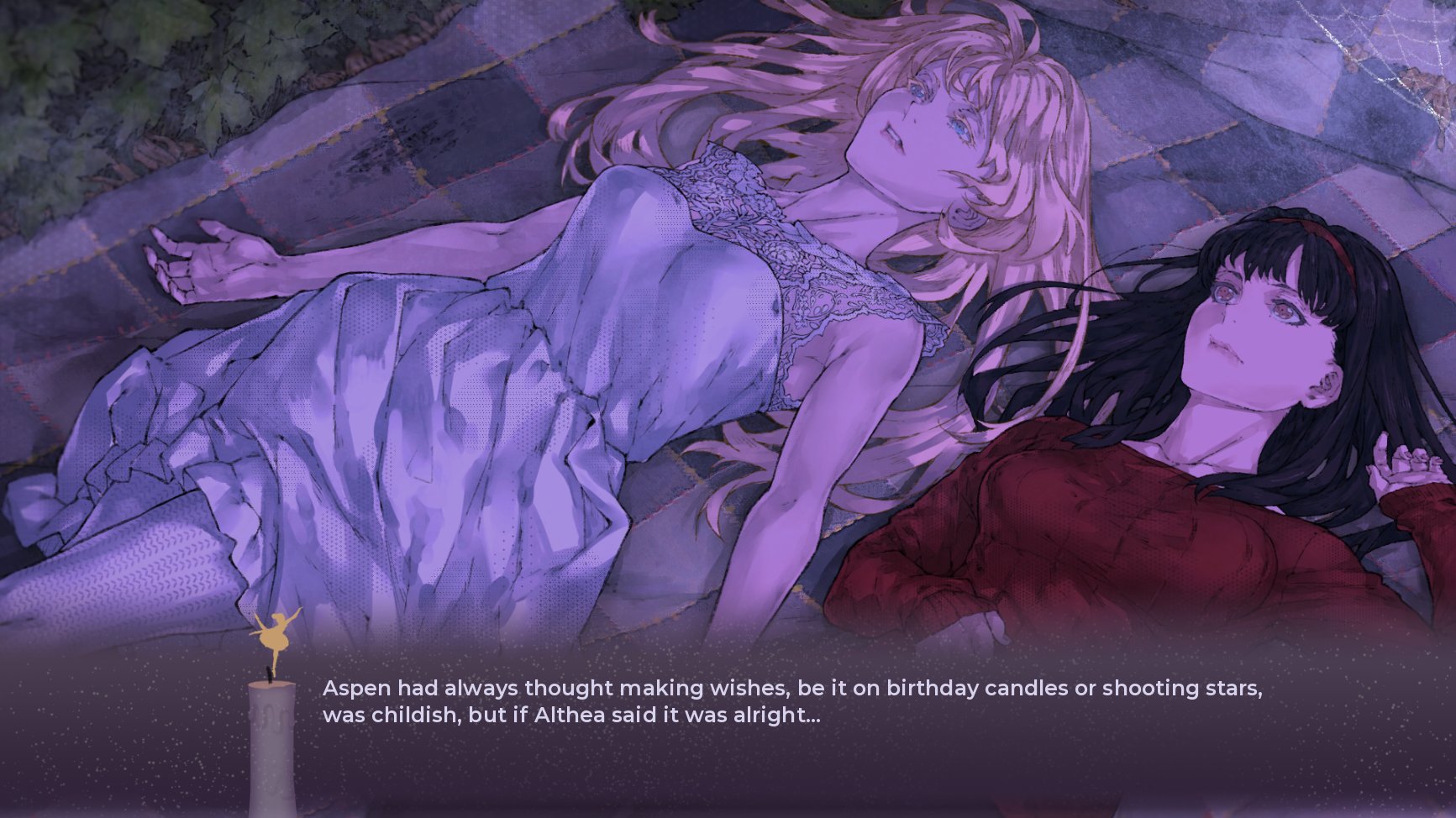
Rituals in the Dark is the story of Aspen, a shy and unassuming teenager who finds herself at the center of unwanted attention after she finds the dead body of her elderly neighbour, Ms Leigh. A few months later, she’s coerced to enter the abandoned and mostly ruined house where she made the disturbing discovery, pushed into it by a game of truth or dare. There, she meets a strange girl that introduces herself as Althea. Borderline-otherworldly in her appearance and behaviour, she quickly dominates Aspen’s thoughts and soon after, a strange romantic tension appears between the two. All this leading to… not much, to be honest, at least in terms of romance progression, or plot in general. The game focuses a lot on building a slightly-unsettling atmosphere and exploring the protagonist’s personality, but if you expect a full-on, conclusive love story, you’ll probably be somewhat disappointed.
                While I personally didn’t find this minimalistic storyline to be a problem, there are things in its setup that I think are genuine issues. While ebi’s protagonists are quite often brooding individuals with low self-esteem, Aspen might be the most depressing one out of all of them, letting others push her around and constantly expressing how average and uninteresting she is. While her attitude might not be unrelatable or hard to believe, it doesn’t make for a very satisfying focus of the story. Also, her behaviour and way of thinking only changes a bit during the game – once more, fully realistic, but not exactly enthralling. What’s worse, I’d place Aspen’s friends, Pippa and Lakhi, in the same category of characters – realistically unappealing – with their obvious personality flaws and poor attitude towards the protagonist making them neither likeable nor particularly intriguing. While they show themselves from a better side later on, they are mostly plot devices that initiate the story and consistently spoil Aspen’s mood.
EJrI107UYAAhASR?format=jpg&name=large
While Rituals in the Night is undoubtedly a yuri VN, you shouldn’t approach it expecting a full-on romance story – it’s quite vague and open-ended in that regard
 
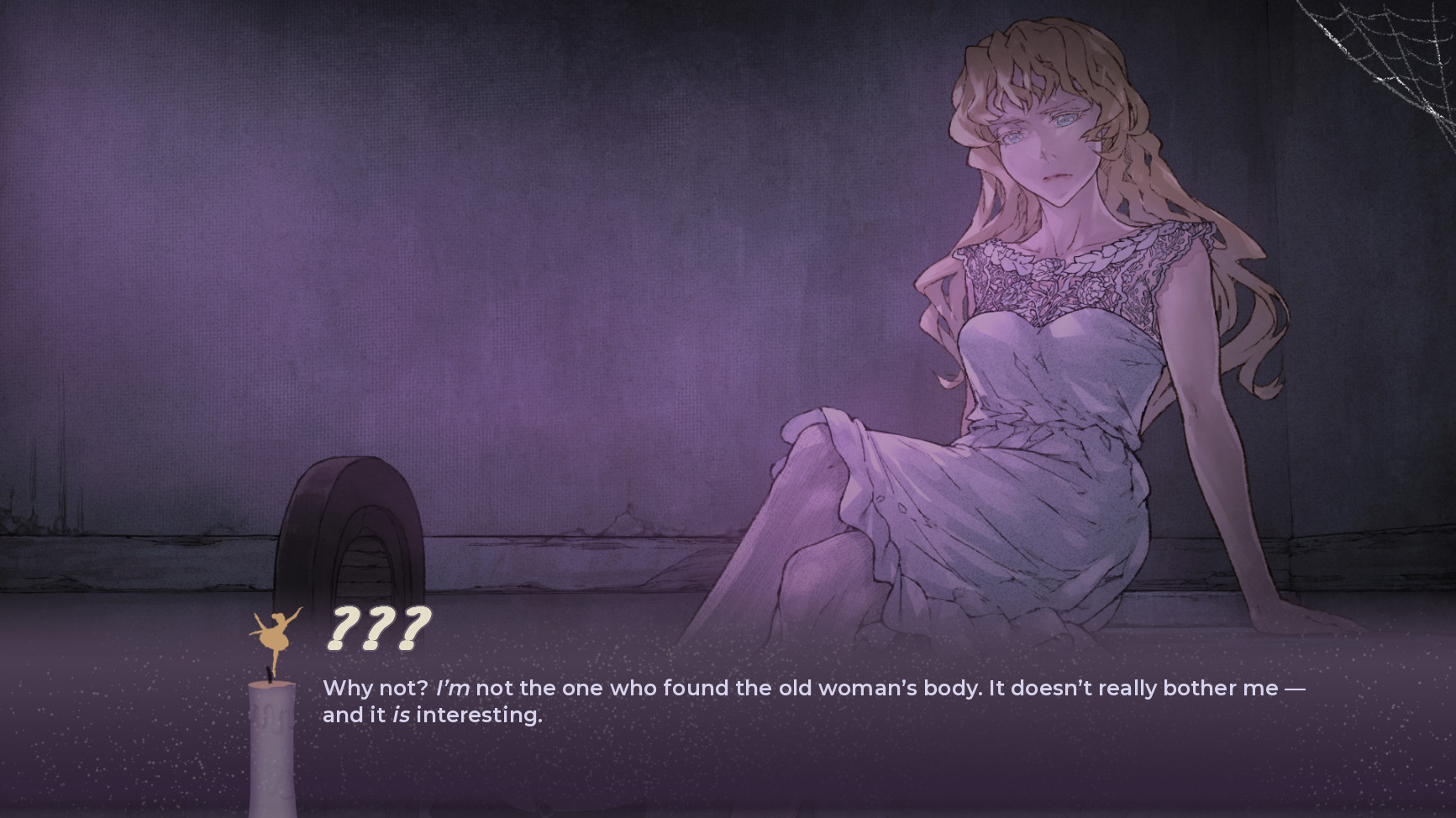
Althea, as an eccentric “wild card” character, is definitely more interesting and has an aura of mystery to her, even after her true identity is pretty clearly hinted at around the midpoint of the story. Ultimately, though, there’s not that much of her in the game, considering how short it is (around 3 hours of reading) and what portion of it is taken by the prologue and Aspen’s internal monologues/things she does between the two girls’ nighttime meetings. We actually learn very little about her and the romance subplot, while definitely present, is in a way cut short before it can bloom into something really substantial. The rather open-ended conclusion leaves us with a few reasons to assume things will work out for Aspen and Althea, but none of that is actually shown to the reader.
                As a final story-related nitpick, I struggle to pinpoint a theme that would define Rituals in the Dark beyond its slightly-unsettling atmosphere and the creepiness of the abandoned house, excellently conveyed through both the detailed descriptions and the game’s visuals. The events it presented were pretty interesting on a moment-to-moment basis, but failed to leave me with a strong impression, or a message to think about. It’s kind of whimsical, existing for its own sake and while that’s not necessarily a negative, it sets this game slightly below most other VNs from ebi that I’ve read. The prose and dialogue are just as polished as effective as ever, just without the substance to make it all truly engaging and memorable.
ss_64cab2f16627bca24d50af7f5d65f33e16981354.1920x1080.jpg?t=1574279893
DarkSin’s art and character designs make the game stand out and are undoubtedly high-quality, although they might not be to everyone’s taste
 
From the visual standpoint, the game is a bit of a mixed bag, although the main assets are very solid. Character art by DarkSin, the same person responsible for sprites in the aforementioned Sweetest Monster, is very stylish and has a mesmerizing quality to it, very fitting for the unsettling motif of the game. It maybe doesn’t work as well here as it did in the aforementioned title, a full-fledged horror story, and I imagine it might even need some adjustment from the reader if they’re used to typical anime art, but it’s definitely well-done, giving the character a lot of personality and a decent amount of expressiveness. CGs are not very numerous, but show up consistently-enough for a story this short. My main gripe in this area is the UI, because both the main menu screen and various elements of the interface simply look low-res and use an unappealing color pallet, more like something I’d see in a free game jam title than a proper commercial VN. It’s a minor thing, but one that managed to bother me through the sheer contrast with the other visuals, and the typical level of polish in ebi's projects.
                The music is appropriately climatic and used conservatively, often fading out in the more tense moments to give space for creepy sounds or similarly unsettling silence. This is a major positive for a game that relies this heavily on ambience and I see nothing to complain about in this regard. And in the end, nearly everything bad that I’d be able to say about Ritual of the Dark’s production quality are more or less nitpicks, while the problems with its narrative are more ways in which it failed to truly impress me, than crippling flaws. Many of the ebi’s VNs are still very fresh in my mind and will quite likely stay with me for years to come, as they showed me stories and characters that genuinely added to my understanding of human nature and the world we live in. As pompous as this might sound, it’s something that good literature is able to do and standard that VNs only rarely are able to achieve. Rituals in the Dark is a very solid game, but not something on that level – which is absolutely fine and considering the very reasonable, $7 price tag, I recommend everyone to give it a chance. After all, by any reasonable metric, ebi’s lower moments are still pretty damn good.
 
Final Rating: 3/5
 
Pros:
+ Unique art
+ Believable characters
+ Well-crafted, mildly unsettling climate
 
Cons:
– Somewhat unappealing protagonist and secondary characters
– Aesthetically below-average UI
– Minimal plot and story progression


VNDB Page
Buy Rituals in the Dark on Steam