Showing posts with label failed VN. Show all posts

Friday, 25 October 2019

Our Lovely Escape Review (English Original Visual Novel)

15a456e6b61875b8a53825c5103c19b3_original.png?ixlib=rb-2.1.0&crop=faces&w=1552&h=873&fit=crop&v=1530672738&auto=format&frame=1&q=92&s=47fd9b0c71dd27b8d5b938a164cb9c78
Few EVN studios leave me with such mixed feelings as Reine Works – a small team creating otome and yuri VNs at an impressive pace since 2017, known for titles such as Blossoms Bloom Brightest and Reflections ~Dreams and Reality~. While I enjoy the ideas behind much of their work and there’s usually a visible improvement in quality with each new release, the storytelling in their games always proved lacking, leaving me either bored or weirded out in the end. Still, I was invested enough to still support their increasingly ambitious and interesting-looking projects, including minor Kickstarter pledges. This is how I ended up playing Our Lovely Escape – a small VN with choosable protagonist gender and three female romance interests, which appeared on Steam in late September 2019, after many long delays. Marketed in a way that suggested a dark twist to every heroine arc, hidden under a façade of a cute, New Game!-like story about an all-female game studio, it seemed to mix many elements I personally enjoy. What I got, however, is quite likely the worst Raine Work’s game to date and will stay in my mind as one of the most upsetting VNs I’ve read to date.
ole_by_szafalesiaka_ddiwksl-pre.jpg?token=eyJ0eXAiOiJKV1QiLCJhbGciOiJIUzI1NiJ9.eyJzdWIiOiJ1cm46YXBwOjdlMGQxODg5ODIyNjQzNzNhNWYwZDQxNWVhMGQyNmUwIiwiaXNzIjoidXJuOmFwcDo3ZTBkMTg4OTgyMjY0MzczYTVmMGQ0MTVlYTBkMjZlMCIsIm9iaiI6W1t7ImhlaWdodCI6Ijw9NzE4IiwicGF0aCI6IlwvZlwvYThiODgzNTUtYzhjNy00YjE2LThhN2EtNGFhOWZjMWIwNGZmXC9kZGl3a3NsLTk4NzdmNjJiLTg1OTgtNDBiYS1hNzFlLTU2NDlhMjZhZTVkYy5qcGciLCJ3aWR0aCI6Ijw9MTI4MCJ9XV0sImF1ZCI6WyJ1cm46c2VydmljZTppbWFnZS5vcGVyYXRpb25zIl19.RoS_p5-0SbXk0BbOLHjiZgD8TYOcSd-JkXzzJDdocEI
This passionate scene coming just a few minutes after Alexis’ drunken barfing session is a pretty solid representation of Our Lovely Escape’s romance

Atypically, I’ll start with Our Lovely Escape’s sex scenes – the main ones show up pretty early in the game, at the beginning of every route. They are also all happening in fairly uncomfortable circumstances: with both the protagonist and the heroine being heavily drunk after a party celebrating studio’s latest release, with very little build-up or romantic tension in the story leading up to it. In most scenarios, there will also be a second h-scene further down the line, usually even shorter and more generic than the first one. As it is often my impression with this kind of games, playing as a woman makes the creepy feel of the initial hookup a bit more bearable – otherwise the power balance, and even the protagonist’s status as an only guy in the studio make much of the prelude to heroine arcs pretty uncomfortable. Even in the yuri variants, however, I’m not sure the sex scenes serve any purpose at all – I’m not a huge fan of hentai, but I can’t remember the last time erotic content in a visual novel left me this indifferent, probably because I simply felt nothing for the characters involved at the point it happened. If you want to buy this game primarily as an eroge, it’s definitely not worth it.
                So, is the story any better? Well, not really. Because there’s barely any story to speak of. The game starts in a rather unassuming fashion, immediately introducing the protagonist – a new employee in a small gaming company making otome VNs – and his three female co-workers. The New Game! influences can be seen not only in the general setup, but even character designs: a shy and secretive Mayu closely resembles Hifumi and strict, professional Lissa gives a similar vibe to Rin. The undisciplined, childish Alexis is a bit of an exception, mostly because the New Game! girls were all meant to be likeable, with mostly positive traits outside of some minor quirks. The main problem with Our Lovely Escape’s cast is that while all of them hold really disturbing secrets, the first impressions they give are also pretty awful. I lost most interest in each of them even before their routes really started, finding their behaviour and the office drama they get into quite obnoxious. The game tries to be something of a bait-and-switch, but really underdelivers on the “bait” part – there’s no reason for the reader to care about any of the characters or get emotionally invested before things go awry, especially with how short and generic the common route is (less than an hour, with the whole game being at around 5 hours of content).
fOGyaN.png
At first, the New Game! parallels are pretty uncanny…

After that, it only gets worse. Psychological horror works best when it introduces some relatable elements or interesting motivations for the characters. Even completely outlandish and brutal VNs such as euphoria can be compelling by creating interesting conflicts, like the dark urges of the protagonist he desperately tries to suppress. Here, the main character is a blank slate, without any interesting traits and a backstory that is only briefly touched upon (mostly consisting of being a childhood friend of Lissa, who watched over him/her for many years before they moved away from each other). The heroines are straight-up psychos, and are so in an obnoxious/edgy fashion that does not leave space for any real character developments of interesting twists. This also spoils the few “good” endings the game offers: knowing the context behind the heroine’s actions and attitudes makes the romantic moments equally or even more riveting than the macabre ones.
                At the same time, Our Lovely Escape also never really commits to its darker side, with the bloody moments never shown in CGs and no truly extreme content. The most disturbing scenes are definitely within Alexis’ route, which is also the only one with no good ending (just neutral and horrible ones), but even those do not introduce any ideas beyond the heroine being a homicidal maniac acting out with little to no provocation. It would be way more interesting if the protagonist was really at fault in some of these situations or proved unstable themselves, but it was really all about inconsistent, not very believable outbursts from the girls. The “plot twists” the game offered left me feeling upset, but for all the wrong reasons – similarly to Carpe Diem: Reboot, by the end I simply hated the story and everyone in it, rather than being unsettled in a meaningful way and feeling for the characters. This actually sets Our Lovely Escape as one of the least enjoyable VNs I’ve ever read story-wise. The minor issues, like some of the blind choices that require pure trial-and-error approach from you to reach your preferred routes and endings pale in comparison to the core issues with the game’s writing.
ss_cdb44116212750778a62afe5ffe028ec5bb69ad5.1920x1080.jpg?t=1569862704
…but they’re very quickly replaced with empty edginess.

Contrasting with the deeply-underwhelming story, the game’s production values are really solid, even if the efforts of the team not always felt well-directed. In this, I’m referring mostly to Live-2D scenes, which show up in somewhat-random moments in both the common route and heroine routes, with relatively little impact. At the same time things like the h-scenes, which could really use some variety or extra visual flair, are very static. Otherwise, I don’t really have any complaints about the art: both visual design and quality of all the assets are really nice and consistent. The soundtrack was a little bit more of a mixed bag – while I didn’t dislike any of the tracks, some of the more dynamic ones, for example accompanying the previously-mentioned office drama, proved seriously distracting. I really prefer my VN music staying safely in the background, unless it’s really great and kicking in during crucial moments of the story. Here is managed to disrupt my reading experience on quite a few occasions.
                As you can imagine at this point, I can’t with a clear conscience recommend playing Our Lovely Escape – and this is a shame, because it was both a game I was seriously anticipating and one that had the potential to be really enjoyable. Psychological horror, even in its more trashy variants, is a fun genre and this VN only needed a little bit of depth and feeling of tension/entrapment to work. Hopefully, Reine Works can take some lessons from its failures and make sure their next move outside of the otome comfort zone is more successful. For readers… I can only suggest skipping out on this one – it’s not even interesting enough in its failures to be really worth experiencing. Truly a shame...

Final Rating: 2/5

Pros:
+ Decent-quality art

Cons:
- Unlikeable heroines
- Rushed story
- Works neither as romance nor as a horror
- Distracting music


VNDB Page
Buy Our Lovely Escape on Steam or Itch.io

Friday, 2 August 2019

No One But You Review (English Original Visual Novel)

merumeruchan.files_.wordpress.com201601noby_keyart-3b38a056e7b6edff4ebd337177dcb137fec891c8-1.png
In our obscure EVN market, there are rarely games or events that could be described as major controversies – even the most unfortunate releases or Kickstarter disasters usually don’t involve enough people and money to gather the attention of the community for a longer period of time or spark a mass backlash. Along with Aeon Dream Studios’ k-pop fan game debacle (a really amazing story of incompetence and borderline-fraud, if you care to follow it), No One But You is possibly the most controversial and polarizing EVN ever released. Appearing on the relatively-barren landscape of early 2015 and promising experience similar to the high-budget Japanese VNs, it sparked a lot of interest and hope for the second coming of Katawa Shoujo – an EVN that would not feel overly niche or amateurish, but actually capture the charm of beloved Japanese titles and rival them in its storytelling.
            The reality, of course, proved much more underwhelming. The unexpected Kickstarter success (the campaign reached over 1200% of the initial, $1200 goal) resulted in a highly upscaled and complex project, developed within just a year by then still-unexperienced Unwonted Studios. Involving a network of over a dozen writers and artists, and a heavily-rushed release (which was never moved from the initial KS campaign claim despite of many major features being added through stretch goals), No One But You was eviscerated by many reviewers, with Fuwanovel notably giving it lowest possible score in two separate articles, and received only a mixed reception from the readers after showing up on Steam on January 2016. In a way, it remains one of the most infamous story-centric EVNs, possibly only beaten by the cheap ecchi titles such as Sakura games in the amount of hate and ridicule it gathered. However, looking at it three years later and with all the fixes and additional content added post-launch, is it really that bad?
ss_dae11f133d6eec049aa63d9322093b78a1acfc16.1920x1080.jpg?t=1478564151
The opening sequences of No One But You make it look like your typical, cute moege with minor mystery elements, making the whole experience something of a bait-and-switch
 
The first thing worth addressing when looking at No One But You is its production quality, which is both one of its biggest strengths and possibly suffered the most from the rushed release. The character sprites and CGs are of really good quality, with all the characters (including the protagonist, who thankfully isn’t a faceless mannequin) being nicely designed and pleasant to look at. The designs of the heroines are admittedly so standard that you can immediately recognize the archetypes each girl represents just after looking at her for a few moments, but that doesn’t nullify the sheer appeal of the character art. This part of the game is also, unlike in many other EVNs from that era, quite consistent both in style and quality – the CGs might not be very numerous or spectacular, but they are good enough to do their job effectively and do not clash with the other assets, while the sprites are pretty and expressive enough to carry the more casual/SoL scenes. Backgrounds, on the other hand, are anything but consistent: while some are absolutely gorgeous, many more, including frequently used ones like the protagonist’s kitchen, look overly-simplistic and undercooked. This might slide if you don’t pay much attention to details, but it’s still a huge shame it spoils the great first impression character art offers. Also, the illustrations are at times clearly mismatched with the game’s text or the scenes that lead up to them, the most striking example being a CG in Yui’s route, in which a long sequence happening on a rainy evening suddenly transfers to broad daylight, with blinding sun rays all over the place. Such obvious mistakes devalue the art and kill the emotional impact of some of those crucial scenes.
                The soundtrack is another interesting topic, as it consists of an impressive number of 34 instrumental tracks, including character themes and melodies unique to important story sequences. It’s not brilliant by any means, but solid enough to enhance the climate of the game and represents a level of effort few EVN devs are willing to put into this area. There’s also the opening song with Japanese vocals, included in an update some time after the initial release of the game – a decent, but arguably pointless addition, as I imagine most people finished the VN before it was implemented and while they could come back for other content added post-launch, such as afterstories and h-scenes, they had little reason to revisit the beginning of the game. This can also be a general comment on how the launch was handled – pushing the game out in such a bare-bones state and fulfilling most Kickstarter promises months later undoubtedly contributed both to many of its persistent problems and the atrocious initial reception it received. Some major promises, like the English voice acting, manga adaptation and a sequel never even materialized, adding to backers' disappointment, while others were realized in a manner that hardly matched what was promised – this particularly applies to afterstories, presented in the campaign as major extra chapters but which proved to be just brief epilogues.
ss_0fbcd19b0ac2a4ac2cc61a967b736baf4d679754.1920x1080.jpg?t=1547764493
The tropy heroines and predictable twists make even the better elements of the story, like the Chinatsu route written by ebi-hime, quite underwhelming
 
So, what No One But You is actually about? The initial setup is as standard as it goes – a perfectly-generic Japanese high-schooler, Hideaki, moves back to his hometown after many years of living in a bigger city. In the new school he quickly manages to make new (female) friends – a cheerful and strangely clingy student council member Megumi, reclusive beauty Shiro, standoffish redhead Yui and a studious senpai named Chinatsu. He also reluctantly becomes friends with the class clown Ryo and at this point, it looks like nothing will disturb his fun in the new school. Only strange, recurring dreams of drowning suggest an underlying mystery connected to protagonist childhood and the reason his family left the town in the first place. If you thought, however, that this game is a moege with slight drama/mystery elements, you couldn’t be more wrong – in depending on the route it varies between a rather poor attempt at nakige to a full-on utsuge, with over-the-top depressing, edgy plot developments and endings.
                Past the average and trope-filled, but reasonably enjoyable common route, the game is at its absolute worst in Shiro’s and Megumi’s routes, the former featuring some comically-incompetent yakuza going after heroine’s father, and the latter a paedophile-murderer teacher who apparently managed to stay in the profession after brutally killing a student in broad daylight, with multiple witnesses. To say these scenarios make little sense is an understatement – they are utterly absurd from start to finish and at times plain uncomfortable to read due to the protagonist’s questionable behaviour. Or course, the worst of his actions are usually completely unavoidable (like the extremely messed up h-scene near the conclusion of Megumi’s route, but also the over-the-top cruel rejection he gives her in Shiro’s arc) – this easily kills the last bit of immersion the numerous plot holes and absurdities didn’t already murder. Yui’s route is mostly on the opposite side of the spectrum, being quite down-to-Earth and using a relatable theme of bullying, spoiling it slightly through the inclusion of some anime romance clichés (notably forgotten childhood promise), but being ultimately pretty sweet and satisfying. It also offers one of the two genuinely good endings present in the game, where for once no one dies or get traumatized for life (that's, of course, only if you make the right choices, as her worst ending is also notably over-the-top). The second positive conclusion available in No One But You is a major surprise – it shows up in Ryo’s route, which might at first look like a throaway scenario for those players that didn't manage to get any of the girls, but quickly transforms into a slightly vague, but still easily-readable BL scenario. Storytelling-wise, it’s arguably the best part of the game – it involves Ryo’s toxic family relations and the feelings of rejection and depression he hid under the façade of a cheerful class clown. Not a particularly novel idea, but still way more interesting than what rest of the VN had to offer and I applaud the dev's courage to include this kind of romance in an obviously male-targeted title.
                The last storyarc I didn’t address is Chinatsu’s route, notably written by ebi-hime (whose pen name was gracefully misspelt as "ebi-himi" in the credits). It’s a fully-linear scenario that is deeply intertwined with the protagonist’s backstory and is overall very competent. However, the main mystery in it is very easy to read, just with the clues offered in the common route and the storyarc itself suffers from the same problem Shiro’s and Chinatsu’s stories did – the overexposure to tragedy and over-the-top plot developments quickly makes you numb and kills the emotional impact the writer was going for. This is also related to the fact that the route, just like all the other ones, felt heavily rushed – with around 10 hours of content No One But You is hardly short for an EVN, but nowhere near long enough to handle five dramatic, complex storyarcs, or develop its cast of characters properly. In a way, it feels like one of those overly-condensed anime adaptations that cut and modify massive source material to fit it into tight screen time, to the point it loses any semblance of coherence or depth. The one, crucial difference being that Unwonted Studios have no excuse for why they let it happen, apart from chasing the unreasonable deadline they set out for themselves.
8x4Xgt4.jpg
No One But You’s visuals, and its production quality in general, are rather good for an EVN of that era, but can only do that much to compensate for often dreadful writing past the common route
 
One of the common complaints about No One But You is connected to its extremely shameless copying of JVN storytelling tropes and stylistics, to the point that even its language looks a bit like a fan translation of a Japanese game. To some extent, however, I think this criticism was overblown – while the game’s setup is indeed extremely iterative, adherence to tropes is not really a major problem past the common route. Also, some “inconsistencies”, like the use of honorifics, seem pretty deliberate – Japanese mannerisms show up mostly in really fun sequences of characters texting to each other, which emulate the style of writing teens would use in that context. While the game definitely struggles with its identity and writers had a hard time restraining their otaku sensibilities, I think even most reviewers would easily look past this if the core story wasn’t so kitsch and, well, plain stupid much of the time.
                One last thing that I should probably mention are the h-scenes – there’s one for Megumi, Shiro and Yui, but I’ll be completely honest that knowing in what context Megumi's scene happens and seeing one still of it on VNDB, I wanted nothing to do with any of it. As I kentioned before, all scenes were added to the game after release, along some other promised features such as the afterstories (those, BTW, in many cases added very little to the respective routes or even attached a new layer of stupidity and inconsistency to them, particularly in Shiro’s case), being more of a minor bonus then a selling point. Other illustrations might be less broken than the one I was referring to, but it’s still probably not something you should seriously take into consideration when deciding whether to give this game a try. And staying on this topic, I'm not sure I consider No One But You worth buying as anything more than a curiosity – it has its moments and won’t bore you the way the recently-reviewed Sakura MMO would, but reading most of it is still akin to watching a burning trainwreck, rather than genuine entertainment. If that’s what you’re looking for, or are interested in it because of its unique place in EVN history, feel free to give it a try, but… You’ve been warned.

PS On the final note, No One But You proved extremely difficult for me to rate. Above all, it's extremely inconsistent and its most off-putting elements are mostly confined to just two out of its five routes. On the other hand, even at its best it can only be considered decent (I'd probably rate Ryo's route, my favourite in the game, at a 3 or 3,5), while at its worst it comes very close to the absolute rock-bottom of awful storytelling available in plot-oriented VNs. If judged by Megumi's and Shiro's routes alone, it would indeed be a clear 1/5, just as Decay and Tyrael claimed in their Fuwanovel reviews. Thus, on the very limited scale I use here, I had no other choice but to give No One But You a 2/5. At the same time, I want to make clear that its actual entertainment value is slightly above other VNs I've rated this low, especially if you skip the cursed routes or read them just for laughs, fully aware of what you're getting into.

Final Score: 2/5

Pros:
+ Good character art
+ Decent common route
+ Yui’s and Ryo’s routes
 
Cons:
- Poor pacing in heroine routes
- Unconvincing, over-the-top plot twists 
- Mostly unsatisfying or illogical endings
- Frequent mistakes both in writing and visual assets
- Cliched as f***

VNDB Page
Buy No One But You on Steam

Wednesday, 19 December 2018

Sweet Volley High Review – What Went Wrong?

svh_by_szafalesiaka-dc1kbx6.jpg 
This review was originally published on Fuwanovel Forums on April 27th 2018.

Outside of new releases, I usually try to avoid reviewing bad OELVNs in-detail, unless they’re especially interesting or notable despite their failures – after all, in any semi-amateur game development scene, the poorly-made, misguided or horribly iterative titles will be far more numerous than those actually worthy of your attention. Writing that much about the former, especially when my goal is to promote OELVNs as a niche worth exploring, is arguably a waste of time and possibly even counter-productive. However, just like Carpe Diem: Reboot, today’s game is a great opportunity to look at some problems and tropes very characteristic of the Western VN scene, in a game that actually had the production values and traces of genuine effort that should at least make it an average, reasonably enjoyable product. And the sin that made it ultimately fail was not silly writing that plagued Carpe Diem, but something arguably even worse – boredom.
            Sweet Volley High, developed by New West Games and released on Steam in October 2016, was marketed as a “yuri/otome Visual Novel”, featuring a female protagonist and both female and male romance options. While some might already feel unease about such use of the terms "yuri" and "otome", both of which usually denotes a bit more than just romantic configurations available, it hints at a much deeper problems – game’s utter lack of personality and very poor use of the themes it tries to tackle. While trying to appeal to a broad audience, in reality, it wasn’t able to replicate the appeal of neither yuri nor otome games, just as it didn’t manage to create a satisfying alternative to those formulas. But, why exactly is that the case?
ss_5e2af23d6702332746213b5de29a443b63118
The game’s art is inconsistent, but is far from being Sweet Volley High's worst element – occasionally the CGs can be quite pleasing to the eye
 
The game’s biggest problem is most likely the protagonist, Aya. This time, however, it’s not about her negative, annoying or unrealistic traits and more about lack of any interesting characteristics whatsoever. An apparently average, even boring lead is not a rare occurrence in the world of VNs. There is one catch there though – normally, there’s either some kind of secret that changes our perception of the MC drastically or something happens that forces them to rise above mediocrity and become a compelling character. Here our lead is simply dull, even in her better moments and also has a quality that for me personally was off-putting – she utterly lacks any charm or femininity that makes yuri VNs different from most of what's available on the market and interesting to read. Her dialogue and thoughts would for the most part fit any faceless, male eroge MC, killing the last possible piece of appeal she could’ve had.
            This problem is deepened by the atrocious pacing of the pretty long common route, during which Aya discovers her passion for volleyball and, for the first time in her life, starts to work towards a goal. The romance options are mostly connected to her high school’s volleyball team (apart from the male route, which features an aspiring soccer player), but it’s hard to emphasize how obvious and uninspired all the plot-points and character introductions feel at this part of the game – surviving the 3-4 hours of reading, until the first choices appear and the romance arcs start to develop, can be a real challenge. There’s a thin line between casual, slow-paced storytelling and showing things that are absolutely mundane and inconsequential and from the first, long episode of Aya looking out of the window during class and explaining how average and bored she is, Sweet Volley High is definitely on that second end of the spectrum.
ss_c019625ed4a9182a40cbc73811643e568f374
Maybe nothing drags Sweet Volleyball High down more than the fact how bland and uninteresting the protagonist is – a sad exception among Western yuri VNs
 
There’s one interesting surprise waiting for those more patient readers though, and that’s the structure of the romance routes. Firstly, in moments when you would expect some of the romance arcs to reach a conclusion and give you a happy ending, the game introduces plot twists and additional layers of drama, that expand the story significantly and give it additional depth. This works especially well in the Nanami 's route, which also feels like the most developed and interesting part of the game. However, the really unusual elements show up in two smaller character routes, both of which only have a bad ending – one leading to your love interest cheating on you, the second one ending with a rejection. While this undeniably enraged many readers, it’s possibly the biggest positive I can find about this game – these “dead end” routes represent a form of realism and respect for the characters that are rarely seen in romance VNs. The failures of the relationships in them do not "come out of nowhere", but are strongly connected to the established traits and life situations of those involved – they're both possible to predict and in a way quite refreshing (even if the actual execution, especially with Eri’s mini-arc, leaves a lot to be desired).
            When it goes to art, the game is fairly inconsistent – there are some very pretty CGs and the sprites don’t look that bad, but they seriously lack variety and some assets are fairly laughable – including some of the hentai illustrations, which are supposed to be one of the game’s selling points. From my perspective, though, maybe the worst of it all is the user interface – it might seem petty to focus on something this “minor”, but in a title where you spend most of your time reading, an aesthetic UI is very important. How it looks in Sweet Volley High, apart from a pretty nasty colour pallet, simply screams generic and uninspired, showing clearly the low attention to detail on the part of the devs.
ss_ce026582860ce5d3fb186dfd8962697f93d8a
The one compelling romance arc is definitely worth mentioning, but it can’t nullify the absolute chore of reading through the common route
 
There’s also one thing that could be counted among the game’s redeeming qualities, but which really even worsened it for me personally – partial voice acting. While I’m already not a fan of that technique (really, either voice your game fully or let my imagination do its job, rather than randomly switch between silent and voiced moments), the way it was done here is even more distracting that it had to be – apart from fully voiced lines, there are voice cues that appear repeatedly in otherwise silent parts of the dialogue – after a few times of hearing “Aya!” at the beginning of an unvoiced sentence I was just tempted to mute voice acting altogether. The only reason I didn’t do it is that whenever full VA is present, it’s actually very decent, definitely above an average quality level for OELVNs.
            In the end, though, the relatively positive elements simply couldn’t change the ultimate problems of the game – its poor pacing, uninteresting lead and utterly unappealing common route, that makes it impossible to really get immersed or care about the characters. What also might be worth mentioning, the game takes place in Japan, but there’s not a single plot element that would really benefit from that fact – it's like if Sweet Volley High actively tried to be the most generic “weeb” title out there, missing out on the opportunity to offer something at least slightly original. Because of all that, it proved to be a thoroughly unsatisfying title and I recommend avoiding it, even if you're a yuri fan.  
 
Final score: 2/5
 
Pros:
+ Good voice acting
+ Bold storytelling choices – not every romance will have a happy ending
 
Cons:
- Boring common route
- Uninteresting protagonist
- Annoying voice cues
- Mostly poor visual design


VNDB page
Buy Sweet Volley High on Steam

Friday, 23 November 2018

Episicava Vol. 1 Review (English Original Visual Novel)

7e534f26c0256d608c9f0684759cbb2e_origina
Chuunige is one of the visual novel genres that are barely present in OELVN scene, at least to any “serious” capacity – among the more popular and high-quality releases there’s very few that would even loosely fit the “fighting VN” formula, or especially effectively replicate the unique feel of this particular current in Japanese fiction. Recently, however, a fledgeling studio under the name of Epic Works decided to remedy this sorry state of affairs by creating a content-rich, Fate-inspired EVN called Episicava. The first volume, of what was apparently planned to become a longer series, was released on Steam in April 2018, in a slightly disastrous state – full of graphical bugs and various technical issues, the game made a rather poor first impression. However, since those problems were mostly fixed with patches in the months after launch, it’s a good moment to look at Episicava and ask the most important question – did it manage, in its improved state, to capture some of the magic of Fate/Stay Night or Dies Irae in a downscaled, low-budget form of an EVN?
Village_burning.jpg
The edgy opening of the VN is just as over-the-top and trashy as the rest of it, but the climate often shifts between brutal, gory action and comedy
 
While Episicava claims to be inspired by classic chuunige, I think it would be much more accurate to think of it as a VN adaptation of some particularly trashy and bloody shounen anime. The first feature it offers in abundance is edge – the game is full of over-the-top violence and gore (although nearly exclusively in textual form – CGs are mostly very tame), with even the prologue featuring a very graphic sequence of protagonist’s (who’s at the time still a young teenager) village and family being slaughtered without provocation by foreign invaders. Later, we go through many scenes with absurd death-counts and our anti-hero killing people rather indiscriminately in his quest for revenge, getting out-eviled only by the cartoonishly vile (and usually pretty dumb) antagonists. The fighting, utilizing confusing and overly-elaborate superpowers, involves other annoying shounen tropes, such as power levels and everyone shouting names of their techniques aloud whenever they use them.
            The protagonist, Arin, is the ultimate edgelord, initially driven solely by revenge and planning a genocide against the nation that he considers responsible for his people’s demise (although, for some reason, the game still starts in a high school setting with him masquerading as a student – after all, we can't just skip on overused tropes). While the game tries to communicate that he has some kind of basic moral code and gives him some development later down the line, he’s still a violent, messed up asshole who tries to resolve everything with brute strength and mistreats people around him, including the heroines, who he insults on a regular basis and even, in one case, coerces into sex (in an h-scene which also pretty much ruins one of the strongest female characters in the story). There’s even a scene where he ponders raping one of the game’s love interests – and while it’s clear where the writers were coming from, trying to portray a character broken and demoralized by his traumatic experiences, he’s primarily a piece of shit that you can barely ever relate to or truly care what happens to him. Some people might be okay with this kind of setup, but I barely ever felt such a strong disconnect between me and the protagonist in a VN – and every time it happened I very much didn’t enjoy it.
phrnss9keefjfiz7mvrq.jpg
The heroines definitely are not the worst part of the experience, but they have only marginally more common sense and likeable qualities than everyone else in Episicava's story
 
Other characters, sadly, are similarly shallow, even though the two romanceable heroines, Alacria (a daughter of one of the game's villains) and Anian (a warrior and heir to a tribal nation's chieftain), are somewhat likeable. The latter probably received more development than any other character in the game and even more than that, she even has a semi-legitimate reason to care about the protagonist, while Alacria pretty much shows out of nowhere and immediately declares a crush on him (the game, by the way, repeats that the protagonist is extremely handsome and generally loved by women to the point it’s hard to tell what the authors were trying to achieve, apart from making the juvenile power fantasy even more obnoxious than it already was). Everyone’s personality and motivations feel underdeveloped and cliched and while the game has a lot of time to build the characters (if offers around 20 hours of reading between all routes), it very rarely manages to do something interesting with them.
            The general plot also offers relatively little excitement, with rather predictable twists and few, mostly meaningless choices (in the vast majority of cases they only lead to an abrupt game over screens or let you access the newly-unlocked route after finishing your first and second playthrough). It’s essentially linear, with three routes and an enforced playing order (starting with Alacria’s route, then Anian’s route and the “true route”, which somehow manages to be the dumbest and least satisfying of them all). The stakes are always kept high, with world-ending conspiracies and global conflicts at the culmination of every story arc, but the silliness of it all and the fact how hard is to really care about the cast make it all fairly insignificant. The same goes to fights, which are actually not terribly done, considering dev’s limited resources and do a decent job of presenting unique fighting styles of the lead characters and keeping them consistent. They, however, get repetitive fairly quickly and often have very little significance for the plot. Without the visual fireworks that would accompany them in an anime series or a high-budget Japanese VN, they start feeling like pointless filler – there was literally a few that get me somewhat excited and felt compelling in their results (for example, the first confrontation between Arin and Alacria and the final showdown of the Anian’s route). Other than that, they just don’t have the kind of impact every fighting VN relies on.
https://steamuserimages-a.akamaihd.net/ugc/915799791359919999/85B1B5ADF9F92C85785F45D151722ABF9C6EC325/?interpolation=lanczos-none&output-format=jpeg&output-quality=95&fit=inside%7C1024%3A*
The protagonist is, of course, a magnet for women – after all, who would not fall in love with an unpleasant, cringy, borderline-suicidal scum like him at first sight?
 
The game’s visuals and sound effects are of decent quality, although not in any way impressive. The fighting CGs are very often recycled, with very few event-specific ones. There’s also a strong disconnect in the artstyle between the sprites and fighting scenes on one hand and the slice-of-life event CGs and h-scenes on the other. The sprites for some characters are fairly similar to each other, which make them even more contrasting with the vastly varied CG designs. The sound effects (like gunshots and explosions) and music mostly fit the “very angry shounen” vibe, but they usually show up in appropriate moments don’t get overbearing (the music at rare occasions might now fit the situations presented on the screen, with tense battle tunes turning on during casual SoL scenes, but that problem currently seems much less prevalent now than it was in the launch version).
            In the end, is Episicava worth reading? Who is it targeted towards? My answer to both is, at best, “I’m not sure”. The game definitely fails in the storytelling department, spewing cliches and obnoxious edginess as its main content. Fights are, ultimately, without much excitement, mostly because only in a few you actually somewhat care about whether the protagonist wins them – and even then, not because of him, but because of the causes he ends up fighting for. The degree to which he’s unlikeable also nullifies much of the pleasure the romance and SoL segments could’ve had – Arin is not enough of a villain or enough of a hero to be compelling and that makes everything around him similarly meaningless. Most likely, even fans of trashy shounen or dumb chuunige won’t be satisfied with Episicava, as the low budget didn’t allow it to be properly flashy and fun to look at. The h-scenes are also too few and far between to make it work simply as a source of fanservice and porn. In result, it ends up being a game for no one and without any merits significant enough to recommend it with a clear conscience, even with the relatively modest asking price. I also wouldn’t expect Volume 2 to ever be created, but maybe Epic Works’ team will learn from this game’s mistakes and their upcoming chuunige, Rainbow Dreams, will improve on the formula (the plot and character description suggest, however, that the cringe factor will be alive and well). For now, I can only suggest staying away from their VNs – there are many, many better things to spend $10 and 20 hours on, even within the EVN niche.

Final Score: 2/5

Pros:
+ Impressive amount of content
+ Decent production values
 
Cons:
- Obnoxious and shallow characters
- Poorly-written story with innumerable plotholes
- Questionable sexual content


VNDB Page
Buy Episicava Vol. 1 on Steam or Itch.io

Wednesday, 25 July 2018

Carpe Diem: Reboot Review - what went wrong?


cdr_1_by_szafalesiaka-dbwit9o.jpg
This review was originally posted on Fuwanovel Forums on January 5th 2018.

Warning: Heavy spoilers ahead! If you want to play this VN yourself, stop reading now.

As much as I’m a fan of independent VNs and appreciate the possibilities that crowdfunding opened for the Western visual novel market, it’s not completely rare for these projects to end with spectacular disappointment, for various reasons. Carpe Diem: Reboot is an especially interesting example of a visual novel that ultimately failed to live up to the expectations, but not because of lack of effort or poor production values, but through the sheer “virtue” of really bad writing. As I’ll be treating this as a case study of how to utterly waste a good concept and a lot of work, unlike my normal reviews, I’ll be revealing many major plot-points, including some details of the games’ endings. As Reboot mostly relies on its plot twists and mystery elements to keep the player interested, if you want to play it yourself, ignore this review or read it after you’ve completed the game.
             While the title we’re talking about was released on Steam in September 2017, after a successful Kickstarter campaign, its history starts a bit earlier, with a free VN from late 2015 simply titled Carpe Diem. This very short, but nicely written visual novel served both as a prologue of sorts and an advertisement for the crowdfunding effort which later spawned Reboot. In it, a simple story about two friends (lovers?), Jung and Ai, deciding how to use a rare opportunity to spend a full afternoon together, ended with a twist – the girl was actually a computer program, an object of delusional love of a shut-in trying to escape from his real life. The Steam achievement for reaching the end of the game, “What are you doing with your life?”, served as a somewhat ironic punchline, making clear the main themes the author tried to tackle. Good dialogues and decent execution of Carpe Diem, while in no way breath-taking, definitely showed promise and made many people (including me, although I've discovered it after the Kickstarter campaign was already over) somewhat enthusiastic about its continuation. So, what went wrong?
cdr_2_by_szafalesiaka-dbwita7.jpg
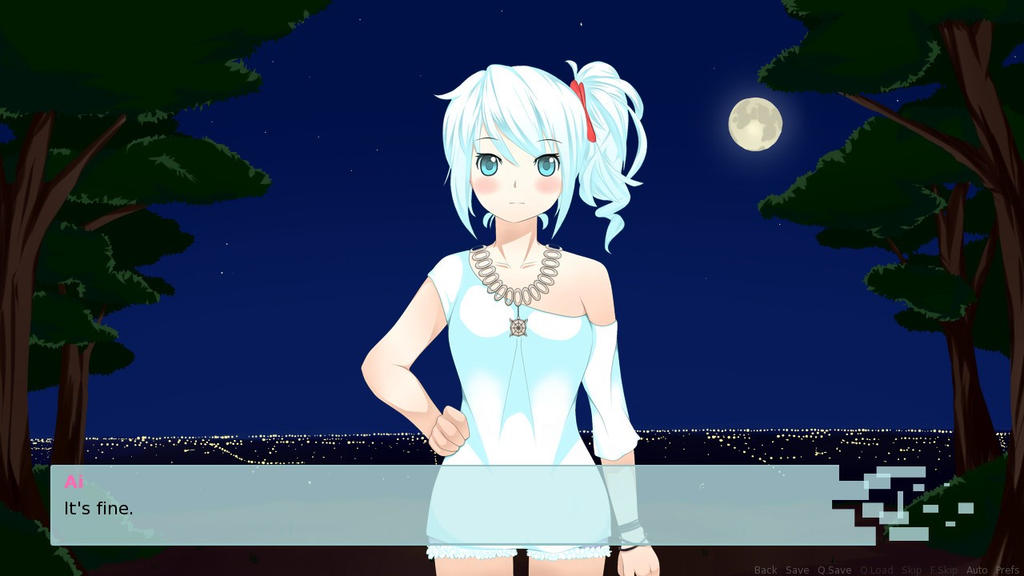
The prologue game, while very minimalistic, showed enough promise to interest people and mobilize support for the Kickstarter campaign – at the very least, it was a brilliant piece of marketing
 
Reboot picks up exactly where the first game ended, that is at the scene of Ai revealing that she’s "not real". We’re soon introduced to the initial portion of drama – she’s a sentient A.I., created by a shut-in programmer, who uses her to earn money by forcing her to take on freelance programming jobs (as she can do them at an insane speed, he’s already got quite rich off her back). Jung, Ai’s creator and our protagonist, quickly proves to be one of the most apathetic and irritating characters I’ve ever seen in VNs – a supposed genius, who absolutely lacks any initiative and during the whole story pretty much follows other characters around and occasionally provides bland exposition. The reasons behind his awful attitude and passiveness are somewhat explained by the end of the story, but doesn’t change the fact he’s an atrocious lead character, never showing any of his supposed skills and virtues. Ai, on the other hand, acts with light-heartedness and cheerfulness of a child, losing the sarcastic edge that made dialogues in the prequel amusing. However, there’s a definite bond between the two, made problematic by one fact – Ai is “dying”, her programming slowly deteriorating and limiting her activity to smaller and smaller periods of time. 
            As a starting point, it’s not an awful piece of storytelling – already we can tell that something’s off in Jung’s behaviour and what’s happening doesn’t really add up (what’s the problem with Ai? Why there’s no backup of her program? Why can’t it be fixed?). The resolution of this part of the story, however, breaks any possibility to treat this VN seriously. Ai, knowing she has little time left, promises to bring Jung one last present for his birthday. She sets up a workplace in a corner of the room, buys two robotic arms and various stuff over the internet and creates… A human body for herself. Not a mechanical body. Not an android. A fully functional, human body, only “with a CPU instead of a brain – because the brain is hardest to replicate".
cdr_3_by_szafalesiaka-dbwitav.jpg
The first plot twist, while surprising, is so ridiculous that it’s hard to maintain any suspension of disbelief. From there, it mostly gets worse…
 
Well, let’s take a deep breath, because this is not where the fun ends. At some point in the first chapter of the game we learn that Jung likes a certain bakery, where he regularly meets a female employee – as it’s a voiced character, we already know she’ll be important. After the first plot twist, he goes there again, taking with him his near-human A.I. companion and thanks to Ai’s straightforwardness and urge to make friends, gets to know the cashier, whose name is Yume. Soon after they learn that Yume is actually one of the best programmers in the world (of course!), and Ai’s rival on freelance programming website she used to make money. Not long after that, Jung somewhat suddenly announces that he was a part of some Illuminati-style secret society and also is a murderer (although pretty much no one cares or even mentions it later), and Ai’s programming is based on some kind of “weaponized software”, created by the evil-splinter-group-leader he had to kill, to prevent him from taking over the world. So, soon the government will be after him and Ai, as her existence is considered a threat. Admittedly, there are some cute, enjoyable slice-of-life moments between the "story development", but they only make the stupidity of the plot that much more obvious and irritating, as every major event immediately takes you out of the experience. 
            However, all these insane plot developments soon lead us to a final decision, which can produce two possible outcomes. In the first one, the protagonist sends Ai and Yume away, to protect them from their pursuers and covers all the tracks behind them. This scenario is concluded with a scene of him standing on a cliff, which suggests that he might have ultimately committed suicide to make sure no one ever finds Ai, but leaves the details to our imagination. This is, however, a non-canon “good” ending. The “true ending” involves Jung trying to confess to Yume, saying that they should sell-off Ai to the government and be together, being harshly rejected as a spineless coward he is, going crazy and murdering Ai (although she later “reboots”, foreshadowing a possible sequel). While I’m not on principle against sad/depressing endings, this establishes Jung as most likely one of the most pathetic characters in the history of visual novels and makes the whole experience, as over-the-top silly as it already was, ultimately distasteful and pointless. The authors definitely went for shock value, but only with a partial success, considering how disconnecting and irritating most major plot-points in the story already were. What could’ve been an interesting tale about the nature of life and the things that make someone truly human (these questions are seriously present in the story), ended up as a kitsch mess, memorable mostly by the virtue of its writing mistakes and ability to make the reader miserable.
cdr_4_by_szafalesiaka-dbwitb6.jpg
The production qualities of the game are beyond what you would expect from this kind of indie project, but they couldn’t possibly save it from being a general disappointment.
 
What makes this truly sad is the contrast between the storyline and the general production quality of the game. While visually it’s mostly just decent, with everything being pleasing to the eye but not in any way exceptional, there’s one thing that definitely makes it stand out from most western VNs – it has high-quality, full voice acting. Actresses voicing Ai and Yume, for the most part, do a great job, while the supporting cast, usually being the place where this kind of productions fall in quality dramatically, is all very much acceptable. Even the casual dialogues, the personalities of the girls and the pacing of the story aren’t awful – they’re simply quite insignificant when confronted with sheer stupidity and pretentiousness of the overarching storyline. 
            Carpe Diem: Reboot is a story of wasted potential – of easily avoidable mistakes, that more or less killed a project which had everything necessary to succeed in a rather spectacular way. Even as it is now, it’s easy to realize the authors’ dedication, hard work put into the game and traces of genuine talent, which with help of a few beta readers or better thought-through development process could produce a memorable, interesting game. What we got, in reality, is a rather spectacular flop, which should be taken as a warning by anyone interested in creating original VNs, and probably any kind of story-driven game. And unless you’re really interested in finding out for your own “if it’s really that bad”, I don’t recommend playing it – there might be a way to find humour in its flaws, but it will ultimately be a waste of your time.

Final Score: 2/5

Pros:
+ Interesting premise
+ Decent art
+ Good voice acting
 
Cons:
- Ridiculous, over-the-top writing
- Repugnant, useless protagonist
- Pointlessly disturbing “true ending”


VNDB page
Buy Carpe Diem: Reboot on Steam