Saturday, 8 August 2020

Stellaren II Review (English Original Visual Novel)

 header.jpg?t=1595524444

Stellaren, released exclusively to mobile devices in 2017 was an important game in my engagement with VNs. A dark sci-fi adventure with a captivating setting and a tense, at times brutal story stood out significantly from most other visual novels available for smartphones and I think to this day is one of the best dedicated Android/iOS games of its kind [you can find my detailed review of it here]. It also cemented my love for VNs as a storytelling formula and while some of that infatuation was definitely connected to me being a fairly inexperienced reader, many elements of Stellaren’s worldbuilding and character development are genuinely bold and interesting – and to the point where I wasn't even bothered by its rough edges and clunky gameplay elements.

                Because of all this, it is an understatement to say I was excited to hear about the release of Stellaren II July this year, coming out not only for mobile devices but also on Steam. Promising heavily updated visuals, a set of better-polished gameplay elements and a substantial, conclusive story (its predecessors had a tendency to end on cliffhangers), it seemed like a massive treat for someone like myself, already in love with this universe. What I found was both different and more complex than I expected – but did it capture the charm and stomach-gripping qualities of the original?
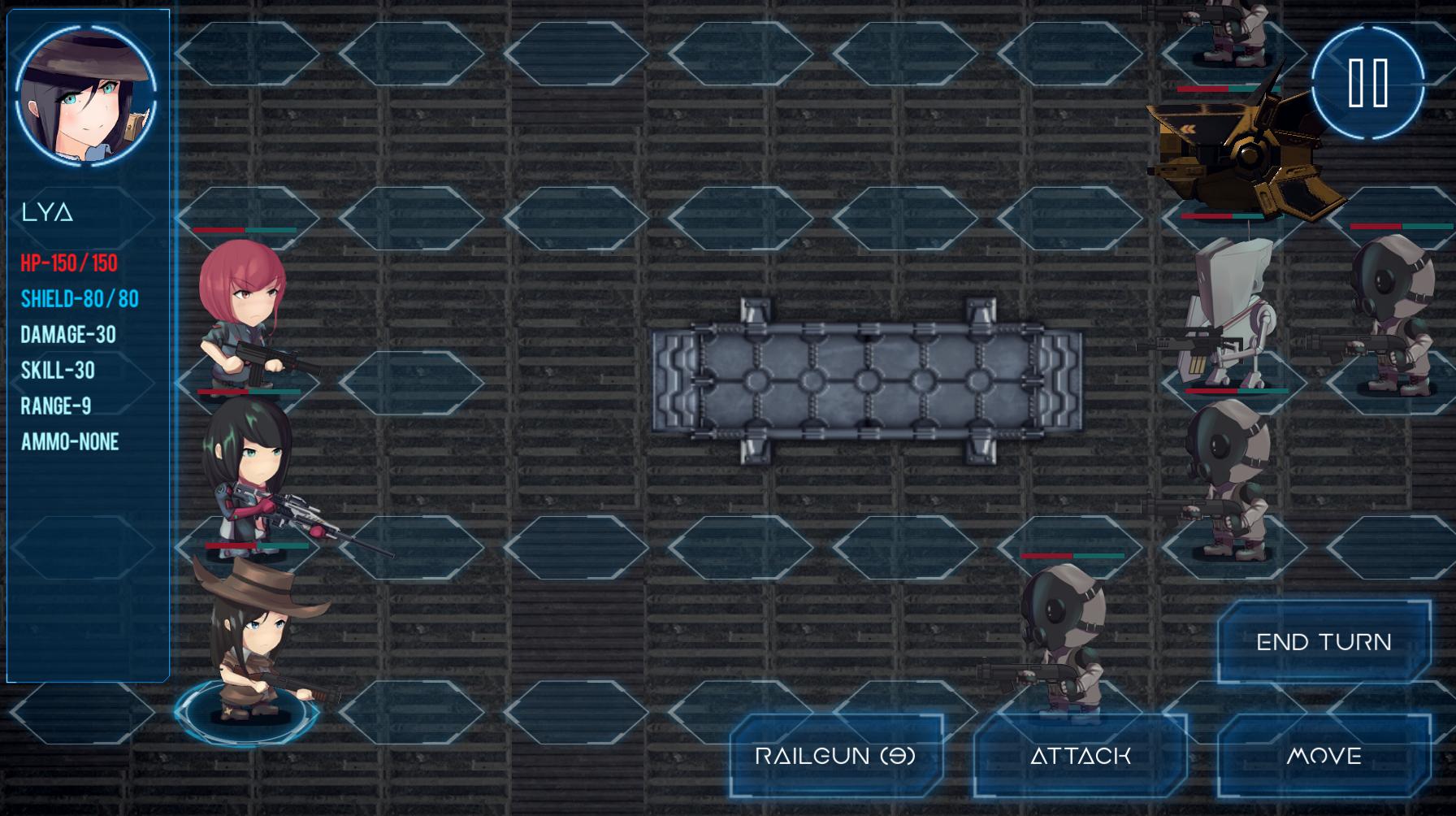
screen-1.jpg?fakeurl=1&type=.jpg
Stellaren II minigames are a massive step up in quality over the first game, and mostly skippable if they turn out not to your taste

Stellaren series is set in far future, where humanity is a space-faring civilisation mostly united under the Neo Galactic Conglomerate – an Earth-based government that manages numerous colonies with an authoritarian and exploitative approach, treating its inhabitants like second-class citizens. A few centuries back this injustice led to a civil war, ultimately won by Earth, while the breakaway faction, the Colonial Rebel Forces, established a ragtag domain composed of most remote human colonies. Over this background, the original game tells the story of M., a junk merchant scraping by on an impoverished planet by scamming NGC pilots. A sequence of unpredictable events gets him trapped on an NGC warship and involved in what would soon become a massive galactic conflict, with the stakes being the survival of mankind as a whole. I don’t want to go any deeper into the lore of the games, as I strongly recommend checking out the first Stellaren – something not necessary to enjoy the sequel (it recounts the most important plot points and most of the crucial lore), but worthwhile by the original game’s own merit.

                Stellaren II is set in the aftermath of the aforementioned conflict, on a remote and relatively isolated mining colony of Horus. It follows a blank-slate protagonist whose neural implants were hacked, forcing him to take part in a brutal rampage in the colony’s starport and wiping out all his memories. With few clues on his identity and past, he ends up working with two detectives investigating the murders: Lana and Rene, private contractors for the Weber Corporation, a powerful conglomerate that is the de-facto ruling power of the colony. Similarly to M’s story, during the 10+ hours experience this initial intrigue gradually escalates to galaxy-altering proportions, eventually linking with the plot of the prequels and giving conclusion to the overarching storyline of the series.

                All that being said, here comes my first issue with Stellaren II – while it works heavily to be a worthy conclusion for the main story of the whole saga, its most enjoyable moments are still connected to the initial 2/5 of the experience, happening on Horus. The two heroines that define this portion, aforementioned Lana and Rene, are interesting and well-developed, and after the game moves to space to pursue its grand narrative, they mostly move to the background, while other characters become the focus – particularly Len, the mysterious ex-NCG operative who appears in the colony following her own agenda and forms an alliance of convenience with the protagonist and his companions. At this point, the game also opens up with a space-travelling interface and several interesting locales, but in my opinion it never manages to recapture the good pacing and emotional impact of the initial chapters.

stlrn_1_by_szafalesiaka_de2r7rm-pre.jpg?token=eyJ0eXAiOiJKV1QiLCJhbGciOiJIUzI1NiJ9.eyJzdWIiOiJ1cm46YXBwOiIsImlzcyI6InVybjphcHA6Iiwib2JqIjpbW3siaGVpZ2h0IjoiPD03MjAiLCJwYXRoIjoiXC9mXC9hOGI4ODM1NS1jOGM3LTRiMTYtOGE3YS00YWE5ZmMxYjA0ZmZcL2RlMnI3cm0tNmJhYmQ0ODUtZjQ5Mi00ODNhLWI5MGQtZWNjZmE4MDhhZGQ2LnBuZyIsIndpZHRoIjoiPD0xMjgwIn1dXSwiYXVkIjpbInVybjpzZXJ2aWNlOmltYWdlLm9wZXJhdGlvbnMiXX0.NZHW3AF-IE79Adk0h_YvzuZ2XOZknO14v9fJXk0Tt0Q
Who the protagonist is to one of the heroines… While the general tone of the story is dark and often brutal, the game offers enough humour and colourful personalities to never feel overly depressing

The next problem of Stellaren II is the sheer complexity of its story, combined with an unusual structure of the experience (at least partially connected to it being a Unity game, rather than one using a dedicated VN engine). With saving only possible at the beginning of every (often substantial) scene, a massive number of choices and an extensive affection system tracking your relationship with over 10 characters, it’s easy to get lost in all the options available to you. What makes it even worse is that the actual goals and consequences for affection building are obscured and nearly impossible to get right on your first playthrough. Often one slip-up can cost you the life of your preferred heroine and deprive you of the ending you wanted, with little to no indication on what you did wrong, or whether an alternative outcome was even possible (there are only two endings currently implemented, but more are being developed). In practice, you’ll likely have to finish the game once getting a default (Len’s) ending and then study the game’s wiki to get any other result – a problem not unheard of in VNs, but hardly an optimal situation.

                All those issues, however, can’t nullify the main strength of the game, that is its writing and worldbuilding. The post-war galaxy it presents is a brutal and chaotic place, with suffering and death ever-present. More importantly, Stellaren II is not afraid to make even its most important characters vulnerable and always handles their (either potential or inevitable) demise in meaningful ways. Every tragedy visibly impacts the protagonist and those around him, but at the same time they cannot give up on their mission, with stakes only rising as the time goes on. The occasional game over screens add to the feeling of vulnerability – the protagonist and his allies are routinely confronted with enemies they have very limited means of fighting against and the game makes it explicit that every bad move might be their last. At the same time, this dark picture is being offset by cleverly-written character interactions and humour, showing that the cast is making the best of their circumstances and adapt to the harshness of their world. Even in my initial playthrough, when I failed to avoid any of the “optional” character deaths, the ultimate message of the story felt hopeful rather than depressing.

                Two areas of the game’s story I found fairly weak are the protagonist and the villains. The lead character is explicitly a blank slate and while we later learn a few things about his past, he does not have the backstory and compelling character arc of M. from the first game. It’s even something of a recurring joke that characters question the reasons for him being included in some events and his connection to the heroines, even though he eventually proves himself as a valuable member of the team. The one positive is that he’s not a harem protagonist who wins every girl’s heart for no reason – the romantic tension in the game is very low-key and mostly shows up if you really push for it with your choices. The antagonists, while properly menacing, lack depth. The main threat throughout the story, a homicidal clone called X2, is simply pure evil, murdering and torturing people without remorse and with somewhat unclear motivations. What’s worse, this is in stark contrast with the character she was created from, the rebel commander X. who served as the initial antagonist of the original Stellaren – someone who might’ve, at first, seemed like a sadistic monster, but showed a lot of nuance and conviction later down the line. The pirate lord Roto, on whom the mid-section of the game is focused, is hardly better, for the most part just feeling cartoonishly vile. Even the broader antagonistic factions, like the Horus' terrorist group called the Butchers could've easily been more compelling, instead of just serving as cannon fodder for battle minigames – particularly because the Weber Corporation they fight against is hardly a benevolent, moral institution.

stlrn_2_by_szafalesiaka_de2r7rc-pre.jpg?token=eyJ0eXAiOiJKV1QiLCJhbGciOiJIUzI1NiJ9.eyJzdWIiOiJ1cm46YXBwOiIsImlzcyI6InVybjphcHA6Iiwib2JqIjpbW3siaGVpZ2h0IjoiPD03MTYiLCJwYXRoIjoiXC9mXC9hOGI4ODM1NS1jOGM3LTRiMTYtOGE3YS00YWE5ZmMxYjA0ZmZcL2RlMnI3cmMtMDU4YjMwYjgtYzhlOC00YTJjLWJlODYtODBkOWUxODg5ZTQyLnBuZyIsIndpZHRoIjoiPD0xMjgwIn1dXSwiYXVkIjpbInVybjpzZXJ2aWNlOmltYWdlLm9wZXJhdGlvbnMiXX0.7sEp8YwqZzo6pNb2R9rP2-yCIu9u09Ui8plKK5qKrcM
Their returning characters and conclusion to the Stellaren’s overarching story should satisfy fans of the series, although the initial chapters on the planet Horus are still the best parts of the sequel... And yeah, we still don't know what those one-letter names are about

Minigames were always a crucial part of the Stellaren experience, particularly with space battles thematically integrated into story segments. Outside of the starfighter sections (this time in the form of a shoot 'em up), the sequel includes tactical ground battles and a real-time infiltration minigame. When it comes to the level of polish they definitely go above the clunky dogfighting from the original, but are still fairly simple. They are also, outside of the infiltrations, fully skippable, making the experience of replaying the game for alternative story paths, or simply for those only interested in the VN content, less painful than it could've otherwise been. At the same time, the one unskippable minigame still gets in the way on new playthroughs, while the ground battles felt very dull to me, with stiff mechanics and snail-paced combat. Even the power-ups bought with credits awarded for winning encounters are simply passive bonuses, offering little in terms of customisation and giving a weak sense of progression. Generally, the minigames were neither a negative nor a major positive in my experience, but I also generally prefer my VNs keeping their focus on the story. One other mechanic worth mentioning is timed choices, showing up in more dramatic portions of the story and often associated with game-overs. My feelings are often mixed on such gimmicks, but here they never overstayed their welcome or became frustrating with their difficulty, while also conveying pretty well the dynamism of some scenes.

                When it goes to the visuals, the game is a major step up in comparison to its prequel, with detailed sprites (including some poses and clothing variants) and a good number of dedicated illustrations, both full CGs and simpler lineart spicing up the crucial moments of the story. Backgrounds are still a mix of 2D art and edited photos, but their quality and tone feels a lot more consistent than in the first game – the original Stellaren took many shortcuts which were possible to ignore when playing on a smartphone, but the sequel avoids such jarring dips in quality or mismatched assets, giving a solid impression even on a large PC monitor. The soundtrack, while mostly composed of stock music, is very consistent with dark sci-fi theme and generally supports the tone of the story very well.

                So, what is my conclusion on Stellaren II? Among mobile-oriented VNs it's still among the best things available, with a compelling story, good production quality and none of the exploitative business model you usually find on smartphone apps (and mobile VNs, curiously enough, are often among the most despicable examples of unethical monetisation and bastardisation of the source formula into a money extortion scheme, with things like CGs, choices or even progressing the story being routinely paywalled). Particularly for fans of the dark sci-fi stories it should be a treat on whatever platform they choose to play it (at least when the paid "pro" version hits the mobile stores – the free one include adds and doens't let you skip combat). On the other hand, some of the elements that made me fall in love with the original Stellaren, like the moral ambiguity of major factions, compelling growth for the protagonist and surprising character development are less present this time around. As a result, the game was both more and less than I hoped for. Despite that, I feel no hesitation to recommend this series to anyone who isn't allergic to gameplay elements and various quirks typical for VNs created in not-dedicated game engines (i.e. missing options and quality of life features). Particularly for the low price of $4, it's a great value proposition and if any of the themes and storytelling techniques I've described in my review appeal to you, you should consider giving Stellaren II a chance. Hopefully, we'll get more smartphone VNs of this quality in the future.


Final Rating: 3,5/5


Pros:

+ Interesting, dark sci-fi setting

+ Well-paced, tense main story

+ Large cast of memorable characters


Cons:

– Fairly weak minigames

– Confusing affection system

– Weak antagonists


VNDB Page

Buy Stellaren II on Steam or play it on Android and iOS

Friday, 17 July 2020

NaNoRenO 2020 Highlights, Pt 3: Romance VNs (Non-otome Edition)

Dl7719.png

Hello there and welcome to the third and final part of my NaNoRenO 2020 highlights! While in the first two posts I focused, respectively, on otome and horror VNs, this last batch of recommendations will be about other romance stories submitted to the event. I have to admit upfront that this is likely the least exciting list of the three, with no game standing out to me in a similar way as Enamoured Risks did among otome entries or Eislyn's Apocalypse did among horror ones. However, there's still a bunch of solid and interesting titles in this category, my favourite being probably Café in the Clouds, with its lovely visuals and memorable dreamworld sequences. Also, the jam has something to offer for fans of all typical romantic configurations, with BxG, BL and Yuri couples strongly represented.

                 As always, all the games I'm writing about are completely free to download, and clicking their titles below will get you straight to their Itch.io pages. Also, I've skipped projects that were submitted to the event but proved low quality or did not offer a complete experience (meaning I exclude all demos and prototypes by default). So, please join me as I wrap up this insane, months-long project of thoroughly covering the biggest NaNoRenO in history – hopefully, you'll find something interesting among my recommendations.


Love Rewind: A Magical Time Travel Romance (BxG/BxB)

Love Rewind is a short romance story with one male and one female love interest, themed around regret and desire to change the past. Yuki, the protagonist and young mage-in-training, loses everything in a futile attempt at saving his terminally ill mother. Broken by this failure and the destroyed relationship with his fiancée Quinn, he isolates himself from the world – an empty, depressing existence that would likely last for the rest of his life if not for the appearance of a spirit, taking form of a cat. This powerful creature forces on him an opportunity to relive and change the events that led him to ruin, and regain the love he lost – or maybe forge a different path altogether…

                  This VN, while a bit rushed and lacking the proper buildup particularly for the BxB arc (Quinn’s route at least have the background of protagonist’s relationship from the original timeline), has a few things going for it. Yuki is a decent protagonist, whose desperation and pain are easy to emphasize with, and the core story has all the satisfaction inherent to plots where you avert a looming disaster. The love interests simply don’t have enough time to develop as characters and truly shine, but they work well enough as incentives for the protagonist to not repeat his past mistakes. The end result is not a great romance VN, but a nice short story in its own right – and one that looks and sounds very solid for a game jam entry.

Final Rating: Recommended

Weekend Fever (BxG)

Weekend Fever is a minimalistic, but emotional story about a writer struggling with burnout, unable to create stories or even find the passion for the line of work switched to after his endeavours as an author died down. While on a short business trip to his hometown, his mind filled with a mix of nostalgia and discouragement from his current circumstances, he meets a stranger – a woman who inexplicably rekindles his passion for writing…

                While the core plot of this VN might not sound very inspired, its value lies in the atmosphere it creates and psychological depth of the main character. Passages of his unfinished book are mixed with rather excellent descriptions of his emotional distress and obsessive drive to create that shows up immediately after he finds inspiration. The visuals and sound are simple, but the colour pallet and distortion effects used in backgrounds create a surreal effect, adding to the slightly detached, nostalgic feel of the narrative. The romance is basic, but full of emotional impact thanks to the fact how connected it is to protagonist’s struggles – all this makes for a satisfying short story, worth experiencing regardless of whether you’re looking for romantic content.

Final Rating: Recommended

Flour Hour (BxB)

Flour Hour is a well-though-out BL romance story weighted down by one massive issue – its prose. The English script is not only full of errors and awkward phrasing typical for non-native writers, but also uses Japanese honorifics in a particularly pointless way, making the whole thing feel like a poor fan translation. Which is a shame, because the underlying story has quite a lot of merit. The main intrigue features Yuki, an owner of a bakery created in place of his grandmother’s flower shop, being approached by a lawyer with claims of massive debt his business owns to a powerful corporation. The desperate struggle to save the titular Flour Hour coincides with a reappearance of Souma, a former boyfriend Yuki never really got over, and increasingly suspicious behaviour from his sole employee, Izumi.

                Flour Hour’s drama and intrigue prove surprisingly in-depth when you get further into the story. While some developments are pretty silly and the choice system maybe a bit too unforgiving, the characters offered more nuance and development than I expected. Souma was probably the most interesting in this regard, as his abrasive and borderline-abusive behaviour becomes much easier to understand when he finally opens to Yuki about his feelings and his experiences after they broke up. At the same time, the story is simply hard to get into with the clunky writing, strangely-stylized visuals and poor-quality CGs. If you can look past those issues, however, the VN might be worth reading not just from the perspective of BL fans – to me, its core plot and the way romance was handled felt very universal.

Final Rating: Cautiously Recommended

Demon Kiss (BxB)

Demon Kiss is quite likely the best-looking and most polished game on today's list, featuring a really cute BxB romantic plot between a socially-anxious computer technician, Felix, and Trisetar, a demon noble that accidentally kidnaps him to hell. Shocked by the human's strange attitude and non-fearful reaction to his presence, the demon gradually lowers his defences as the two are stuck together for a few months (time necessary to recreate the spell for travelling to the human world).

                Despite the pleasing art and generally fun, lighthearted storyline the game is not without some issues, the main being its pacing. There is an overarching plot connected to Trisetar's initial appearance in the human world, but it's basic at best and generally stays in the background of the developing romantic tension... Which also doesn't develop as much as it probably should. With no bad endings or really tense moments, the story has a pleasant flow to it, but fails to get the reader engaged other than on a very superficial level. As the result, I would only truly recommend reading this one to dedicated BL fans – while the humour and the final plot twist are fun enough even for an average reader, the main focus is the fluffy BxB love story that should mostly satisfy people who are explicitly after that kind of content.

Final Rating: Cautiously Recommended

At First Sight (BxB)

At First Sight is an unusual story utilizing a very interesting concept – in a world where everyone has a destined soulmate with whom they spend their whole life, the protagonist, Grimes, approaches his forties without finding one. When Dreams – a rare form of premonition happening to the Unsouled and hinting at the identity of their future partner or the circumstances they’ll meet under – start appearing to him every night, he’s more terrified of the uncertainty of following the visions and possible disappointment than he is encouraged. And when he finally decides to act on his premonitions, what he finds is detached from his expectations way more than he ever feared…

                At First Sight is technically a BL game and gay romance is present in it in some ways, but above all, it’s a story putting various romance clichés on their head. Grimes is an unpleasant and frustrated person, and in the world where everyone receives a happy ending by default, he ends up with something that even in the best possible interpretation can hardly be called a love story. His reactions are often nasty, even beyond what is justified by his depressing position, making his a relatively unlikeable protagonist. However, the way the game explores the idea of soulmates, and the strange situations and tensions it creates in its world is genuinely interesting – for that element alone At First Sight might be worth investing around 30 minutes necessary to complete it.

Final Rating: Recommended

Kill the prince!? (BxB)

Kill the Prince!? is a tiny story about a thief hired to assassinate a prince kidnapped by a rival kingdom and forced to marry their princess. Cute and very humouristic, the game gradually reveals the connection between the protagonist and his target, while also delivering amusing dialogue, a cast of exaggerated characters and silly puzzles centered around switching disguises.

                The game’s art is in decent part composed of simple lineart or rough sketches and the whole experience is very brief (20-25 minutes to fully read through), but it has enough charm and wit to justify its existence. The love story in it is also lovely to the point where even someone like me, who usually struggles to get into BL games, genuinely enjoyed it. If you’re looking for a short, fun distraction rather than a deep story, this one is definitely worth it.

Final Rating: Cautiously Recommended

Café in The Clouds (GxG)

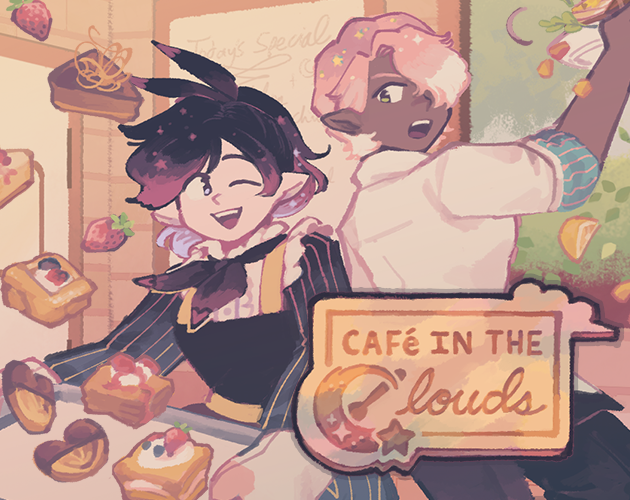
Café in the Clouds is a short yuri VN with point-and-click adventure game elements. It tells a story of two women running a very unusual café in a modern-fantasy setting. Outside of simply serving food and coffee, they possess magical powers that enable them to enter their client’s dreams and help them deal with nightmares, or even deep-rooted problems disturbing their nightly rest. The game’s plot focuses mostly on one such case – a client that visits the café (or rather passes out at the entrance) to ask for help with their severe insomnia.

                The romantic elements in this VN come in the form of relationship between the owners of the café, Remerie and Somnia. The interactions and banter between them are very cute and a near-constant feature of the brief story, accentuated by pleasant, pastel-painting-style visuals. Other than that, the player has to deal with a few simple puzzles (and a single unnecessarily cryptic one at the very end) to navigate the client’s dream and find a way to clear out the issues preventing them from resting at nights. The game also teases a larger story, connected to the couple’s mentor and original owner of the café – a story I would be quite interested in reading, considering what a genuinely nice experience Café in the Clouds proved to be.

Final Rating: Highly Recommended

Tender Feelings Like Water (GxG)

Tender Feelings Like Water is a short, supernatural love story about a water spirit that gains a sense of self and after long years, maybe centuries of loneliness falls in love with an unsuspecting human girl. Disguising themselves as another woman, the spirit starts interacting with the mysterious "girl in red", wary to not reveal their true identity – not just due to possibility of scaring her away, but also because the river, the personification of which they are, took away a lot from both the girl and her village in general...

              As simple as this VN was (also when it comes to the visuals and the soundtrack, which are both not unpleasant, but basic), I couldn't help but enjoy its nostalgic storytelling and emotional conclusions (there are two endings, similar to each other, but different in subtle and meaningful ways). It's a yuri romance in a very loose understanding of the term, but should satisfy most fans of the genre with its climate and interesting dynamic between the main characters – and maybe other readers too, if they adjust their expectations properly.

Final Rating: Cautiously Recommended

In Peaceful Days (GxG)

In Peaceful Days is a Fire Emblem: Three Houses fan fiction VN expanding on the Empire route and Edelgard romance (with female Byleth). It focuses on a rare day off, when both the protagonist and the Empress have some time to spend together, away from political intrigues and military conflicts. Byleth sets to prepare a perfect evening, interacting with other characters from the source game and visiting important locations within Garreg Mach.

                A short, cute piece of (non-sexual) fanservice, this VN has enough visual polish and humour to satisfy the fans of the original, but even for someone like me, who never played Three Houses and only did short research to know the context of the story, it was pretty fun to read.  It also has the advantage over many projects of this kind that it's not going outside of the canon with its main pairing and character interactions, but elaborates on one of the possible endings of Three Houses in a believable way. Recommended primarily for Byleth/Edelgard fans, but not necessarily just for them.

Final Rating: Cautiously Recommended

Honourable Mention:

Full Service Shop (GxG/Non-Binary)

Full Service Shop is less a romance story and more a lesbian/non-binary erotic game using its sci-fi setting to create a number of really interesting, softcore scenarios for the player to go through. It features a nameable protagonist in the late 21st century, where advanced cybernetic implants are widely available. This includes the ability to enhance or replace one’s genitals and our main character is on their way to such a procedure, choosing a small, peculiar workshop – the titular Full Service Shop. There they’ll be able to not only choose their new implant (which changes how the scenes play out in minor ways) but also one of the four technicians who will not only install the new implant but give them a thorough “test drive”.

                As trashy as this premise might sound, it’s handled in a quite interesting way, with each technician offering a unique backstory and sex scene, the latter ranging from short and vanilla to complex and kinky. Visuals are tame, majority of the time stopping at partial nudity, so most of the work is done by the genuinely high-quality writing. The stories revealed in the conversations with the technicians and the erotic content itself utilize the futuristic setting, for example by discussing digitalizing the human mind and spicing things up by manipulation of neural implants, providing the much-needed variety when compared to your typical erotic VN. The one complaint I have about the game is arguably a major one – with average visuals and choices that don’t add too much to the experience (apart from initial choices of implant and technician, they mostly can just cut the scenes short), to the point the whole package would work just as well, or maybe even better as a short story. Still, if you’re looking for an unusual, wholesome erotic VN to read, this issue hardly makes it less of a valid choice.

Final Rating: Recommended


And this is all for today's list and, by extension, my coverage of the NaNoRenO 2020. The non-otome romances that showed up this year mostly failed to truly impress me, but games like Cafe in the Cloud still managed to provide fun experiences while a few other proved memorable by escaping the usual tropes and story structures. There are also a few slice-of-life titles that I might add to this post as further honourable mentions – the enormousness of this year's event makes my work of covering it constantly feel incomplete, but for the most part, it's done. I hope you enjoyed what I provided here and will consider giving a chance to VNs I've recommended – I'll do my best to repeat this process next year with NaNoRenO 2021 and this fall with Yuri Game Jam 2020. But for now, thank you very much for your time and I hope to see you again!

Saturday, 4 July 2020

Eldritch University Review (Yuri Visual Novel)

Note: I was provided with a free review copy of the game by the developer. All opinions are solely my own.

Sequels to obscure, low budget EVNs are always a slightly awkward topic to tackle. They are inevitably tied to games which few people are familiar with and which can be, at least in some aspects, of subpar quality simply due to their indie nature. This makes giving a meaningful rating and recommendation for potential readers tricky – at the very least, any kind of conclusion about them will be served with a good number of caveats, related to the interplay between titles in the particular series and the value proposition they represent both together and on their own. The latest title to create such a conundrum for me is Eldritch University by Jackkel Dragon.

                Released on Steam in June 2020, this game is a sequel to early 2019’s Eldritch Academy, a supernatural horror VN combined with a fair dosage of high-school yuri romance. While amusing in its romantic arcs, the prequel had several issues: unlikeable protagonist, repetitive routes, below-average visual and, in my opinion, an unreasonably high price for the level of quality it represented. University, while borrowing the setting and tying itself loosely to the core intrigue of that game, represents a major improvement in most aspects – a better-looking, more focused experience with a price tag way more representative of its entertainment value. Is it, however, good enough to make the whole series worth it, or to be a viable read as a standalone experience? Well, it depends on what you want from it…

The troubled relationship between the protagonist and her girlfriend is the most interesting part of the game – and the most satisfying, when you finally see them succeed

Eldritch University follows the story of Kasumi, a college freshman that was recently reconnected with Misaki, the girlfriend she was separated from three years earlier. A secondary character from Eldritch Academy, Kasumi was the person who unwittingly unleashed the supernatural threat that game's story revolved around and nearly got killed in the process. Still bearing some emotional scars from the incident, she was mostly able to regain her easy-going attitude and is happy to work on rebuilding her relationship with Misaki. However, when the wound she sustained back then starts giving off strange symptoms, and creepy stories of apparitions begin popping out around the campus and the surrounding town, it becomes clear that the horror is far from being over.

                I won’t try to hide it: if there’s one thing I deeply enjoyed about Eldritch University it is the love story between Kasumi and Misaki and the way it is tied with the overarching supernatural intrigue. Initially, Kasumi herself is a bit of a bubbly airhead, while Misaki is more timid, but also kind and friendly. As, in the prequel, we briefly observe the couple in their high school days, they are outgoing and over-the-top affectionate to each other. However, the circumstances of their separation (forced by Misaki’s conservative mother) and the time they spend apart change that significantly. Misaki’s is weighed down by the social stigma and rejection she suffered due to being a lesbian, while Kasumi struggles to adapt to her changed behaviour and the doubt on whether the connection they once had can be fully rebuilt. In both of the non-dead-end endings, this dynamic gets resolved in a satisfying and heart-warming fashion, while never overdoing the drama and keeping the emotional and psychological profiles of both girls very believable. Coupled with a romantic, non-explicit sex scene, this makes Eldritch University a real treat for yuri fans such as myself – I was genuinely surprised and impressed with how impactful it was.

The game’s supernatural story feels somewhat rushed and underdeveloped, but also avoids repetition and filler content that plagued Eldritch Academy

The horror intrigue is less developed and is probably the only aspect of the game which I would consider weaker than it was in Academy, which focused a lot on stress and desperation of fighting against a supernatural threat. It ties directly to the events of the first game and creates a few genuinely tense scenes, but its main value is, once more, in the well-executed interplay with the love story. The character most important for the horror arc, Kasumi’s friend Hinata, plays into her insecurities and confusion about Misaki’s behaviour – this leads to a few interesting choices influencing the main couple’s relationship. On the other hand, the are also blind choices with unpredictable consequences in horror scenes and the pacing of the whole mystery plot feels rushed. With frequent time skips and rapid story developments, the sense of looming danger and despair, for which the game was definitely aiming, is only half-there. Also, surprisingly little was added to the series' overall lore and worldbuilding – it neither showed anything truly new about its supernatural elements nor opened interesting story threads for possible continuation.

                Then we get to the issue of secondary characters, who can be hardly described as anything more than plot devices. Two girls helping the protagonist and Misaki, Yuri and Shizuka, are a tie-in from the author’s book, Shireishi, but without the extra context someone who read that would probably have, they’re simply exposition props. Other minor characters barely show any personality either – Kasumi’s other friend, Hiroshi, is probably the only meaningful one among them. And at last, there’s the issue of actual relevance of knowing Eldritch Academy, as the really important parts lay not in the main plot of that game, but in the unlockable bonus content – short episodes showing the circumstances of Kasumi and Misaki getting separated and the way they adapted to their new situation. They add weight to the drama of University, but hardly justify investing time (8-10 hours) and money ($12) in the prequel. Honestly, I would just prefer to see a recap of Eldritch Academy and the scenes expanding on Kasumi’s and Misaki’s stories in University, as a skippable prologue – it would make it much easier to recommend it not only to people familiar with the first game (or interested in reading it), but also those that want to jump straight into the sequel.

Outside of Kasumi’s two friends, Hinata and Hiroshi, the secondary characters in the game are more plot devices than anything else – and even these two receive relatively little development

The visuals are a clear improvement over Academy, but are still pretty basic. While the sprite designs look more clean and expressive than they did in the prequel, the low amount of detail and simple shading are still very much visible. CGs look solid most of the time, but are ultimately on the same level as the sprites and occasionally even struggle with perspective. The end effect is hardly an eye candy, but very serviceable. The same can be said about music, which… Exists. It’s a very generic set of background tunes, but never gets in the way or fails to match the climate of the scene, which is good enough in my mind.

                So, what’s my conclusion on Eldritch University? It’s a game that struggles a bit with its identity, stylising itself as a horror story but hardly committing to this theme. However, for yuri fans that enjoy a more grounded approach to LGBT+ issues, it has enough to offer to easily justify the $6 price tag (for 3-4 hours of content). Also, for people that enjoyed Eldritch Academy or specifically look for the combination of supernatural thriller and GxG romance, it should prove satisfying. For anyone else, it might be a much harder sell… But if anything I wrote here sounded interesting to you, I still suggest giving it a chance – if not for the full price, then at least grabbing it on sale. And if this dev’s work continues improving in this manner, their next game might be very easy to recommend, even to a broader audience.


Final Rating: 3/5


Pros:

+ Excellent romantic subplot

+ Likeable and well-developed main cast


Cons:

– Average-at-best visuals

– Rushed/underdeveloped supernatural horror storyline

– Underdeveloped secondary characters


VNDB Page

Buy Eldritch University on Steam or Itch.io

Friday, 19 June 2020

Nothing & Nowhere Review (English Original Visual Novel)


Note: I was provided with a review copy of the game by the developer.

To talk about the latest slice-of-life VN by ebi-hime, nothing & nowhere, we have to start in a less-than-obvious place. Nearly two years ago I made an overview ebi’s freeware games and one of the most memorable and unique of them was Lynne: a heavily stylized, pixelart horror game about a teenager crumbling under pressure from her dysfunctional family and societal expectations she's unable to truly meet. Full of suffocating atmosphere and visceral dream sequences, it is to this day one of the most effective horror experiences I’ve seen in the medium and one that ends on an abrupt, but appropriately disturbing note. Nothing & nowhere, while representing a completely different climate and stylistic, is basically an alternative timeline spin-off of that game, offering something probably every person that read Lynne wished for – some form of respite and hope for the future to the game’s tortured protagonist.

                Interestingly enough, after being released in mid-May 2020, nothing & nowhere was not marketed directly as a sequel or spin-off of Lynne. Even the Steam page only mentioned the connection at the very end of game’s description, suggesting it’s above all a standalone story, despite sharing the central character with its horror predecessor. In my experience, however, it was exactly that link, and the extra context being familiar with Lynne provided me with, that made the new game a truly worthwhile. More than that, I’m willing to argue it's likely be the same for most potential readers, for a few crucial reasons.

The mystery behind the main character’s appearance near Cora’s village is not particularly compelling (and nearly turned void if you read Lynne), but the real appeal of the story is her path to overcoming the persistent issues that made her escape her previous life

The core story of nothing & nowhere is a very slow-paced, nostalgic slice-of-life story, similar in feel and scope to one of the other recent titles by ebi, Rituals in the Dark. Through third-person narration, it presents the story of Cora, an eccentric writer living in a small village in rural England, and a mysterious girl she finds one morning on a local beach, exhausted and drenched from the cold, autumn rain. Assuming the Girl (that’s the only way she’s referred to for most of the game’s story) run from home, she decides to give her shelter, opening the story of their unusual and slightly strenuous cohabitation. The main axis of the story is about the Girl and her path to overcoming the depression and anxiety that drove her into running away from her previous life – however, her specific circumstances and motivation are not the only, and not the most interesting mystery. That honour undeniably goes to Cora – an extravagant and successful young woman, living a reclusive life in an old-fashioned cottage in the middle of nowhere. Always perfect in her appearance and borderline-boastful about her achievements, she gives few hints on what drove her to this lonely way of life. Even while her relationship with the Girl grows deeper, she reveals very little about her past and wittingly diverts any attempts at prying into it.

                Here, however, we’re already landing on the biggest issue I have with the game – the reveals, when they happen, are not as impactful as I hoped for and the path that leads to them have too few memorable moments. The dynamic between Cora and the Girl is pretty amusing, with Cora using her rhetorical skills and life experience to not only solve the “mystery” of the Girl’s presence in the remote village, but also steer her in a direction of overcoming her deep-seeded problems. Her patient and considerate attitude, hidden under a layer of teasing and caricatural self-confidence, is heartwarming and makes a great basis for a believable story of healing and finding a new path in life. However, especially combined with the Girl’s depressive passivity, it does not create many impactful scenes or spark genuinely interesting tension between the two women. This results in an experience most appropriate for people with a really high tolerance for relaxed slice-of-life content, with no real twists of shifts in pacing involved.

While the context of Lynne adds a lot of meaning to nothing & nowhere’s story, it also exposes its biggest weakness – lack of tension and few emotionally impactful moments

Here we come to the aforementioned connection with Lynne and its significance. The main reason I think it’s important, is because it gives a much deeper look into the Girl’s backstory and the suffering she went through, making her recovery way more meaningful and satisfying to see. Also, the epilogue is filled to brim with references that will mean relatively little to people not familiar with the previous game. At the same time, I can’t shake off the feeling that deeper crossover from Lynne’s storytelling devices and unsettling climate would make nothing & nowhere a more compelling experience. Referencing more directly the girl’s traumatic nightmares and intense suffering we saw in that game would make the process of overcoming them and Cora’s involvement a lot more engaging to follow. I respect the fact that was not the kind of story ebi wanted to tell and that’s at least one of the reasons she didn’t tie this game to Lynne so explicitly, but it makes me particularly worried about its viability as a standalone experience. Without the appeal of an alternative take on an already-known story, there’s not that much here to hook the average reader with – even romance, the most obvious magnet for a broader audience, is relegated to brief backstory section for Cora.

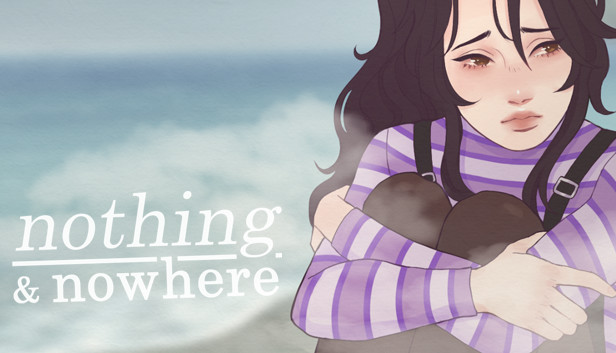
                On the other hand, what might draw people in, outside of the story details, is the art, high in quality and utilizing a distinct, non-anime artstyle. As usual with this kind of stylistic, I needed a bit of an adjustment period after approaching the VN and I’m still not sure how I feel about the eerie, doll-like look of Cora’s sprite. However, the general impression from the game’s visuals was definitely positive. The backgrounds were nicely detailed and all assets felt very consistent in style and level of detail. The CGs were few, less than 10 in total, but the minimalistic story hardly demanded more custom illustrations to fully get the message across… Although just the fact I can’t think of another scene I would like to see illustrated, other than maybe the last sequence of the epilogue, reinforces my point about the (relative) lack of memorable moments.

The non-anime art in nothing & nowhere has a peculiar, doll-like feel to it, but all the assets are unquestionably high-quality and very consistent in style

The last thing that has to be mentioned is the music – very relaxed and rather minimalistic, which puts it perfectly in-synch with the overall tone of the story. Generally, the cohesion between all layers of the experience in nothing & nowhere – story, art, GIU and music – was extremely high, which is something I deeply appreciate. I still, however, wished that the substance of it all was a bit more dynamic and hard-hitting. I’m tempted to say that the soul-crushing experience such as Lynne deserved a just as deeply uplifting sequel, but even disregarding that point, I simply feel this story idea demanded execution either longer and more in-depth, or more vivid and dramatic. Some will surely disagree with me, but this is the only honest assessment I can give. At the same time though, if you enjoyed Lynne or if you’re willing to read it before buying this game, it should be very much worth experiencing – and with the prequel being free and this game costing just $5, there are few reasons to not give them a try.


Final Rating: 3/5


Pros:

+ High-quality, stylistically consistent visuals

+ Pleasant music

+ Satisfying, uplifting alternative scenario for fans of Lynne


Cons:

– Pretty forgettable as a standalone story

– Very slow-paced and minimalistic storytelling


VNDB Page

Buy nothing & nowhere on Steam or Itch.io

Saturday, 6 June 2020

NaNoRenO 2020 Highlights, Pt 2: Horror (Updated)

Dl7719.png

Hello and welcome to the second part of my NaNoRenO 2020 coverage, where I’ll be going through the most noteworthy games submitted to the most recent edition of the biggest EVN game jam. While in the first part I focused on otome and other GxB romantic VNs, this time I’ll tackle the niche that, in my opinion, contained some of the best projects in the whole event – horror. Once more, I’ll be focusing on complete projects, rather than many demos and prototypes that get submitted to NaNoRenO – and thanks to the extended deadline devs worked with this year, that’s still a lot of interesting content.

                One game from the previous post, Dream Dilemma, also fits into this week’s theme besides featuring GxB romance – however, it was a rather unremarkable, simplistic game and most of those I’ll be writing about today are anything but that. So, please join me in this quick overview of NaNoRenO 2020 horror VNs – and as always, whenever one of them catches your attention, clicking its title in the list will get you straight to its Itch.io games. Of course, all the titles I’m covering are completely free to play. Let’s have some scary (and slightly messed up) fun!


Divilethion

Divilethion is far from your typical scary VN, tilting more to the side of grotesque horror-comedy, with visuals and writing style that contrast heavily with the grim essence of its story – and do so in a brilliant, at times hilarious way. The game follows Lynn, a young high priest in an isolated village “protected” by a monstrous god named Divilethion. While the entity is the only guarantee of survival for the community surrounded by monster-infested swamps and regularly plagues by disasters, the price for its “miracles” is steep – every time, a villager has to be sacrificed and his heart fed to Devilethion. Lynn, cynical and disturbingly diligent about his duties, is soon put to the greatest test yet by the apparently bored deity, asked to sacrifice one thing he might not be willing to give up…

                As serious as this story setup might sound, what sets its tone as primarily a dark comedy is Lynn’s warped perception of the reality around him and the grotesque enthusiasm Divilethion requires from his worshippers. This combined with an unrelenting writing style, never shying away from harsh language and disturbing story developments, creates a striking experience that will likely keep you engaged all the way through, to either a relatively-positive or deeply unsettling conclusion. While overall the game is relatively short, it’s just so full of personality and meaningful story developments it’s hard to not be satisfied with it. I deeply recommend checking it out – very few hour-long VNs left me with such a strong impression.

Final Rating: Highly Recommended

My Bunny

My Bunny is well-stylized horror VN about a troubled girl accompanied by a sinister imaginary-friend character in the form of an anthropomorphic bunny. Isolated and bullied in school, with hints on traumatic past on top of it, the protagonist is fighting desperately to improve her life against all odds, while her every failure results in the stronger presence of the bunny, always whispering depreciating and violent thoughts. A chance meeting with a local graffiti artists finally offers her some respite and hope for the future, but a tragedy so long in the making is not easily averted…

                A solid premise and presentation of My Bunny is sadly at least partially wasted due to a rushed and poorly written ending – while I understand what the devs were going for, the behaviour of certain characters and options offered to the player at the end of the game are underwhelming. The bunny himself is also strangely underutilized, not influencing the plot as much as you would expect and rarely receiving genuinely interesting dialogue. Ultimately, while not bad, My Bunny is another one of those NaNoRenO VNs that leave you pondering its lost potential at least as much as its actual story – which is a shame, but maybe shows the possibility for its authors to produce something truly memorable in the future.

Final Rating: Cautiously Recommended

Eislyn’s Apocalypse

Eislyn’s Apocalypse is arguably the most narratively-involved and complex games in this year’s NaNoRenO, and my personal highlight of the event. While similar stories of a secret conflict between cosmic beings over the future of humanity, along with the quasi-Lovecraftian stylistics have been done in VNs countless times, this one is noteworthy for its uncompromising approach to horror – confronting the reader with disturbing, genuinely apocalyptic scenarios, unavoidable outside of the unlockable true ending. Each of the four bad routes shows something crucial about the game’s world and characters, giving context and emotional buildup for a deeply satisfying “real” conclusion. This structure by itself, of course, is also not new, but it’s a while since I’ve seen it done in a game jam project in such a deliberate and effective way.

                What is it exactly about, though? The VN follows a few protagonists, often switching perspectives, although the central character is always Adrianne – a strange young girl with an inexplicable connection to the monsters lurking the dark corners of the once-idyllic city of Memora. While the whole intrigue starts with an investigation to a series of murders, performed by a private detective recruited by concerned citizens, it escalates rapidly in every route, reaching often truly epic proportions. All the major characters, whether supernatural or average people, will be involved in an ancient battle between good and evil – and one in which the balance of power is definitely skewed in favour of the evil, while its corrupting influence makes the distinction between friend or foe less than clear. Outside of very average visuals and a pretty limited set of CGs, there’s little to complain about here – characters are compelling, the world-building fascinating and the plot emotionally involving with constantly-rising stakes. I won't write anything more to avoid spoilers, but if you wanted to read just one VN from this year’s NaNoRenO, this one would be a good choice.

Final Rating: Highly Recommended

#Influenced

Once more touching on the recurrent NaNoRenO theme of great ideas with half-assed execution, #Influenced is a short horror story about an aspiring social media influencer frustrated with her lack of progress. After meeting with a trending Instagram model that recently moved to her area, the protagonist is given the contact to the girl's mysterious manager – one that can deliver near-miraculous results, but every time asks his client to sacrifice something... Honestly, I find this topic extremely compelling, as not only those looking for fame and money on the web, but even small creators such as myself are often exposed to similar pressures – the drive to find recognition and reach an audience, with techniques most effective in this regard not always being in line with personal integrity and self-respect. I still remember the grossed out feeling when the owner of a site I wrote an article for showed me a search-engine-optimized version of my work, and that's hardly the biggest compromise one can make to get traction as an internet personality or creator...

                However, there are few things in #influenced that prevented the cathartic feeling I was hoping to get from it. The first is the protagonist herself, as I think she is unnecessarily shallow and envious of other people's success. It would be a lot more interesting to see someone more sympathetic and hard-working fall into the same traps, as the social media sphere in its current, oversaturated state is not exactly fair or easy to break through even with good ideas and genuine effort. The second and most damning issue is the pacing – then the game starts being truly unsettling and tense, it doesn't build up the atmosphere and properly represent protagonist's descent into madness, but simply rushes to the conclusion in a rather unsatisfying fashion. That part left me deeply disappointed, as even the slightly preachy feel of the story didn't prevent it from becoming genuinely interesting at certain points. So, while I don't necessarily discourage giving this one a chance, set your expectation appropriately low if you decide to read it.

Final Rating: Cautiously Recommended

Epistle in a Bottle

No NaNoRenO since Digital: A Love Story can be complete without an OS-simulation-style VN, and Epistle in a Bottle fills this obligation in a pretty standard, retro-stylized fashion. The protagonist is an office worker handling communication in what seems to be the early 90s. Handling company email and distributing information between his co-workers, he starts his day doing mundane tasks, until a strange, unsigned message launches a chain of increasingly disturbing events.

                While this game does not always do a great job when it goes to building a narrative, I can't help but appreciate the feel it has and the way it approaches the user interface – you switch between your computer, the telephone and physical messages that end on your desk in a pretty immersive way. As you control the main line of communication between your company's boss and various parts of the office, you have a central role in both the mundane workflow the game starts with and the emergencies that soon follow. Eventually, things get way too over-the-top and the game sadly lacks genuine ways of influencing the plot, which kind of goes against its highly-interactive storytelling formula and various ways in which it could accommodate player choice. Still, for me, it was a fun little experience and if the aforementioned interface gimmicks are something up you alley, it should be the same for you.

Final Rating: Cautiously Recommended

Honourable Mentions:

Spellbroken

Spellbroken is more a supernatural thriller than a straight-up horror story, but it’s something that should be satisfying to fans of the genre due to its themes and effective writing. The game is set in a modern fantasy world where the society was deeply transformed by the appearance of witches – women born with powerful magic abilities, often hard to control and extremely destructive. The protagonist is a handler – a member of a militarized formation dedicated to subduing witches. Working under the Church, the de-facto ruling organisation of her city-state, she’s convinced that she’s performing grim, but necessary work for the good of her people. However, her next mission into the wilderness will shake that conviction in several different ways…

                Like this developer’s first project, Package Chat, Spellbroken is above all an excellent piece of mature writing, full of uncompromisingly-crafted characters and minimalistic, but effective worldbuilding. Without excess exposition, it manages to construct a complex and original fantasy setting, along with some compelling axes of conflict for the main story and a few arguably brilliant twists. The crude personalities and motivations of Collie’s handler companions sometimes balance dangerously on the line of becoming caricatures, but for the most part, they’re refreshing in their naturalism. The art, while simple, is nicely stylized and enhances the isolating, desolate feeling of the “Wild”, where the vast majority of the story happens. On top of all this, Spellbroken offers some yuri romantic elements, which were a bonus for me, but they were also pretty minor and I recommend checking it out to everyone regardless whether or not they care about w/w romance plots – it’s just that good of a (short) story.

Final Rating: Highly Recommended

Limbokin

The last game on today's list is also not "true" horror, but something the visuals and narrative choices of which should appeal to many fans of the genre. Limbokin is an interesting short VN telling a story of a boy who dies with a lingering regret and ends up in purgatory. There, with help of another “limbokin”, as the inhabitants of this realm refer to themselves, he sets to connect to the living world for the last time and reconcile with his beloved older sister, an argument with whom let to him his untimely death.

           While utilizing horror-like, creepy imagery and a somewhat disturbing premise, Limbokin is above all a bittersweet slice of life tale, including some really wholesome and uplifting moments. Despite having just an hour of content (with three paths/endings), the game explores in an interesting way the relationship between the protagonist and his sister – an older teenager struggling with her identity and first serious love. On top of that, it briefly touches on the backstories of other inhabitants of the purgatory and offers a particularly amusing twist for Rafa, the girl that acts as protagonist’s guide in the world of the dead. The end effect is quite unorthodox and compelling – with the strong presence of LGBT+ themes, it reminds of the more original, high-quality Yuri Game Jam VNs. And if that sounds like something that you might enjoy, you should definitely check this one out.

Final Rating: Recommended


And this is it when it goes to horror VNs in this year's NaNoRenO – there are a few ones which I purposefully skipped on listing, mostly due to them being too simplistic or low quality, although there are two I still owe a shoutout. The first one is Sleepy Agent's Unfamiliar Work, which kind of overwhelmed me with its abstract visuals and confusing storytelling, to the point I'm not sure what to make of it – still, it's definitely very different and I encourage anyone curious about it to try it out and maker their own mind. The second one, the Saya no Uta fan game by Arcane City, I didn't touch, as I simply haven't read the original game yet and thus wouldn't be able to assess it properly. I'm still pretty convinced though that the three games I did cover and most strongly recommend in this post are among the very best projects in this year's NaNoRenO. Also, in the cases of Divilethion and Spellbroken, they come from authors with highly developed styles, who I'm pretty sure will deliver more of such excellent stories in the future – apart from checking out their current work, I strongly suggest following their future endeavours.

                For the time being, I'll be taking a short break from NaNoRenO coverage, while I tackle the latest slice-of-life VN by ebi-hime: nothing & nowhere. However, you can expect at least one more post in a few weeks, where I'll be focusing on non-otome romantic stories. I hope you've enjoyed this overview so far – for me, NaNoRenO is a celebration of the creativity within the EVN scene and it's hard to overstate its value, both as a training ground and promotional space for devs, and a gathering place for the fans of the genre. Sharing the message about the exceptional games that show in it every year and engaging with their authors is deeply satisfying to me and even if a fraction of that enjoyment passes onto you guys, it makes all this work worth it. Thank you for reading and, hopefully, see you next time around!